


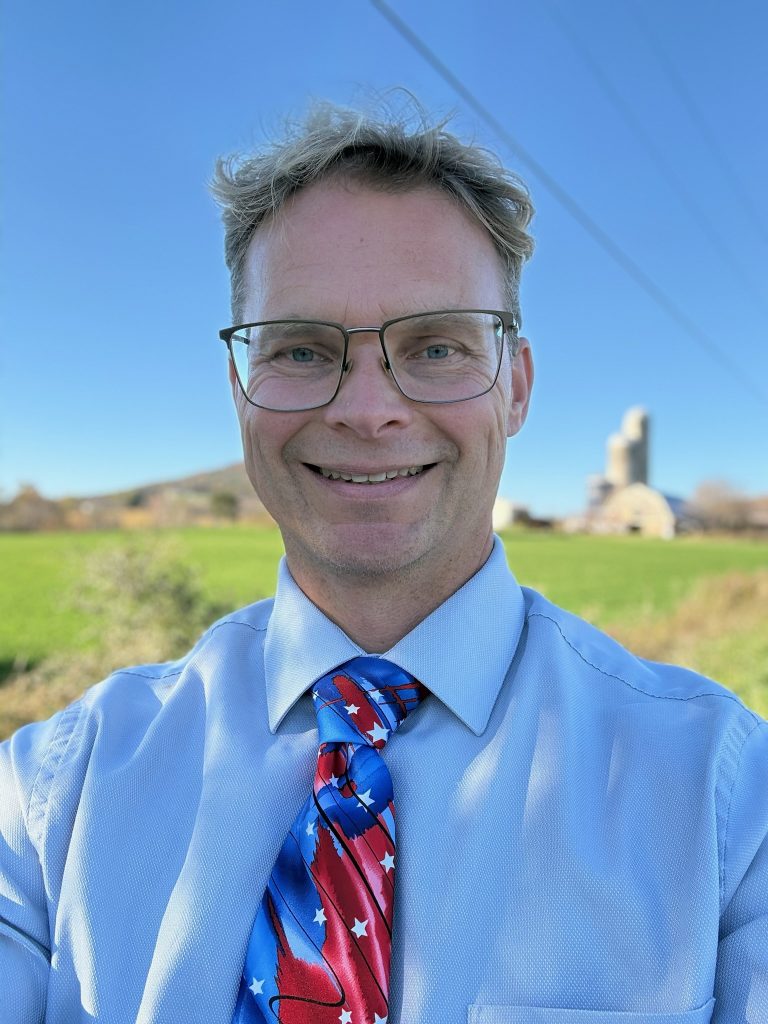
Christopher S. Friend is a Republican and Conservative Party candidate who has represented the 124th Assembly District of the New York State Assembly, including parts of Broome and Chemung Counties and all of Tioga County, since 2011. Friend has a master’s and Ph.D. in chemistry from the State University of New York at Buffalo and worked as a chemist before entering politics.
Questionnaire responses have been edited lightly for clarity.
How does your background and previous experience qualify you for this position?
I am a lifelong resident of the Southern Tier, grew up in Big Flats and graduated from Horseheads High School. I earned my bachelor’s degree in chemistry from the University of New Hampshire and my master’s and Ph.D. in chemistry from SUNY Buffalo. Before entering public service, I worked as a research chemist, which taught me to analyze evidence, solve problems and evaluate whether proposed solutions actually work.
My public service began locally, advocating for community projects and serving on the Big Flats Parks Commission. I then served in the Chemung County Legislature before being elected to the State Assembly in 2010. That experience has reinforced my belief that government works best when it is accountable to the people it serves. I bring a scientific background, local government experience and a commitment to fiscal responsibility, economic opportunity and representing the interests of Southern Tier residents in Albany.
What makes you a good candidate for young voters and students?
Young people deserve the opportunity to build a future in New York without being priced out of the state. Whether you are attending Binghamton University, completing a technical program, entering the workforce or starting a business, you should be able to find good opportunities and afford to live in the community you call home.
My priorities include reducing the tax and regulatory burdens that discourage businesses from investing and creating jobs, improving access to affordable and reliable energy and expanding economic opportunities throughout the Southern Tier. We should also strengthen career and technical education and better connect our educational institutions with employers who need skilled workers.
Students should be able to make their own decisions about their futures without government making those choices harder through excessive costs and unnecessary restrictions. I want young people to have a reason to stay in New York, build careers, raise families and contribute to their communities. That requires an economy that rewards hard work, encourages innovation and gives people a fair chance to succeed.
What motivated you to run for this position?
I grew up in the Southern Tier, and this region has always been home. Growing up in a large family with seven siblings taught me the importance of hard work, responsibility and looking out for others. My parents also had a tremendous influence on my commitment to public service. My mother served 21 years on the Horseheads School Board, dedicating much of her life to local education, while my father served on numerous community boards. Their example showed me that making a difference begins with getting involved in your own community.
My path to public service began locally, advocating for community projects and comprehensive planning in Big Flats, followed by service on the Big Flats Parks Commission and in the Chemung County Legislature. I eventually ran for the State Assembly because I wanted to bring that same commitment to our communities to Albany.
I have always believed that the people closest to a problem often have the best understanding of how to solve it. Unfortunately, too many decisions in Albany fail to recognize the needs and realities of upstate communities. I ran for office to give the Southern Tier a strong voice, promote responsible government, protect taxpayers and create opportunities for families and businesses.
My motivation is also deeply personal. My wife and I have raised our four children here in the Southern Tier, and I want them to have the same opportunities to build meaningful, successful lives in the community that helped shape who they are. I hope they will be able to stay here, establish their careers, raise families of their own and enjoy the quality of life that makes this region special.
Ultimately, my motivation remains the same today as it was when I first became involved in local government: I want the next generation to have the opportunity to build a good life right here in the Southern Tier. This is where I grew up, where my values were formed and where I chose to raise my family. I want to ensure that our communities remain places where the next generation can put down roots, find good jobs, raise children and build a future without having to leave the place they call home.
What do you view as the biggest weakness of the current administration, and how would you do things differently?
The biggest weakness is an overreliance on expanding government programs and mandates without adequately addressing the underlying reasons New York has become so expensive for families and businesses. New Yorkers continue to face high taxes, rising energy costs, housing affordability challenges and concerns about public safety. Adding another program or issuing another mandate does not necessarily solve those problems, particularly when taxpayers are left to pay the bill.
I would take a different approach by prioritizing fiscal discipline, lasting tax relief, regulatory reform and policies that encourage private investment and job creation. We need to evaluate government programs based on measurable results, eliminate unnecessary spending and give local governments and communities greater flexibility to address their own needs.
Energy policy is another example. New York needs reliable, affordable power to support households, manufacturers and future economic growth. We should pursue a practical energy strategy that includes natural gas, nuclear power, renewables and emerging technologies rather than imposing mandates that risk increasing costs or undermining reliability.
Public safety must also remain a fundamental responsibility of government. We should be willing to revisit policies that are not working and listen to law enforcement, correctional officers and the communities affected by those decisions.
Ultimately, I believe New York needs a government that is more accountable, more disciplined with taxpayer dollars and more focused on creating opportunity. Our goal should be to make this state a place where people want to live, work, study and invest.