





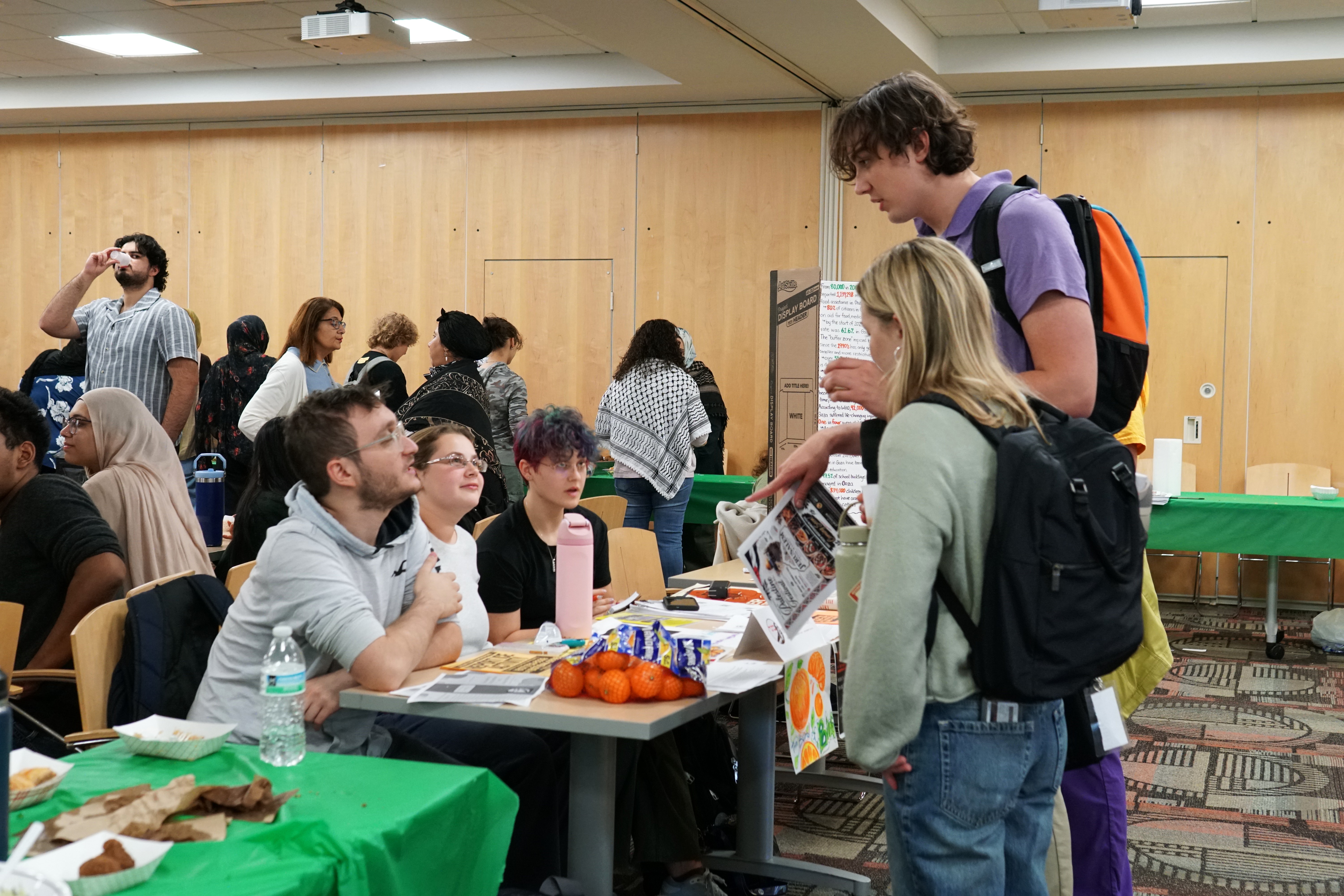
The Center for Middle East and North Africa Studies held the third-annual Palestine Cultural Festival at Chenango Champlain Collegiate Center on Monday evening.
In celebration of Palestinian culture, the event highlighted the tradition, artistry and history that often fade into the background amid the ongoing humanitarian crisis in Gaza.
The room was set up in a configuration of three rows of tables, each representing organizations with diverse missions. Festivalgoers were able to wander up and down the aisles, stopping and engaging in a range of activities and conversations. The tables included small crafts, cultural pieces for sale and informational poster boards regarding Palestinian identity.
The intimate room was filled with bustling conversation and lively music, as attendees were encouraged to indulge in free food and drinks while strolling through the space.
In the back of the room was an array of traditional food, including mains, sides and desserts, along with refreshments. Some of the options included musakhan, a traditional Palestinian dish made of roasted chicken baked with onions, warak enab, grape leaves rolled and stuffed with rice, and herbs and beef and basbousa, a syrup-soaked cake.
Some of the organizations present included the Arab Cultural Student Association, Students for Justice in Palestine, Binghamton Solidarity for Palestine and the Muslim Student Association.
Lubna Omar, an affiliated faculty member and previous associate director of CMENAS, discussed the need for the event.
“We wanted to show how deeply connected Palestinian culture is to the broader Levant region while also celebrating what makes it uniquely distinct,” Omar wrote. “We are highlighting our unique traditions—from traditional embroidery (tatreez) to our music, food, and art—and focusing on the resilient ways we keep our living culture alive, especially within the diaspora and refugee communities.”
Among the organizations tabling at the event were Women in Hebron, a Palestinian nonprofit fair trade cooperative aimed at supporting women living in Hebron, a city in the West Bank. All of the goods sold by the organization are handmade by a collective of 150 women living in the city, providing them and their families with an additional source of income to supplement part-time employment.
At the event, the business sold handicrafts including embroidered rugs and bags, displaying tatreez, which directly translates to embroidery, but is associated with traditional, geometric Palestinian design.
Other tables at the festival incorporated interactive art-making, including painting and multimedia craft-making.
Centered around calligraphy, one table provided bookmarks to be painted and designed and included information about the artistic and cultural expression that calligraphy holds in both Palestine and Pakistan. The MSA provided paper and pipe cleaners, encouraging attendees to make poppies out of the materials, a flower significant to Palestinian culture.
“This festival is a great way to show the Palestinian culture that people don’t normally see,” said Nema Sayeed, the president of MSA and a senior majoring in biomedical engineering. “As you can see, it’s a great way to unite all these different people from different places standing towards one mission, one same thing.”
Another table focused on henna, where attendees could get traditional designs on their hands and read about Palestinian traditions surrounding henna and the cultural influence henna has in the Middle East, North Africa and South Asia.
Omar shared her view on how important it is to create a space for Palestinian culture to be celebrated on campus.
“For millions of Palestinians outside of Palestine, our culture is what we have left, and at times it feels like it is slipping away,” she wrote. “It is crucial for us to keep it alive and stay connected to it. If our culture is gone and the land is contested, there are no Palestinians — so maintaining the various aspects of our culture is truly an existential issue for us. Creating this space allows us to honor our heritage, foster solidarity, and ensure our identity continues to thrive.”