





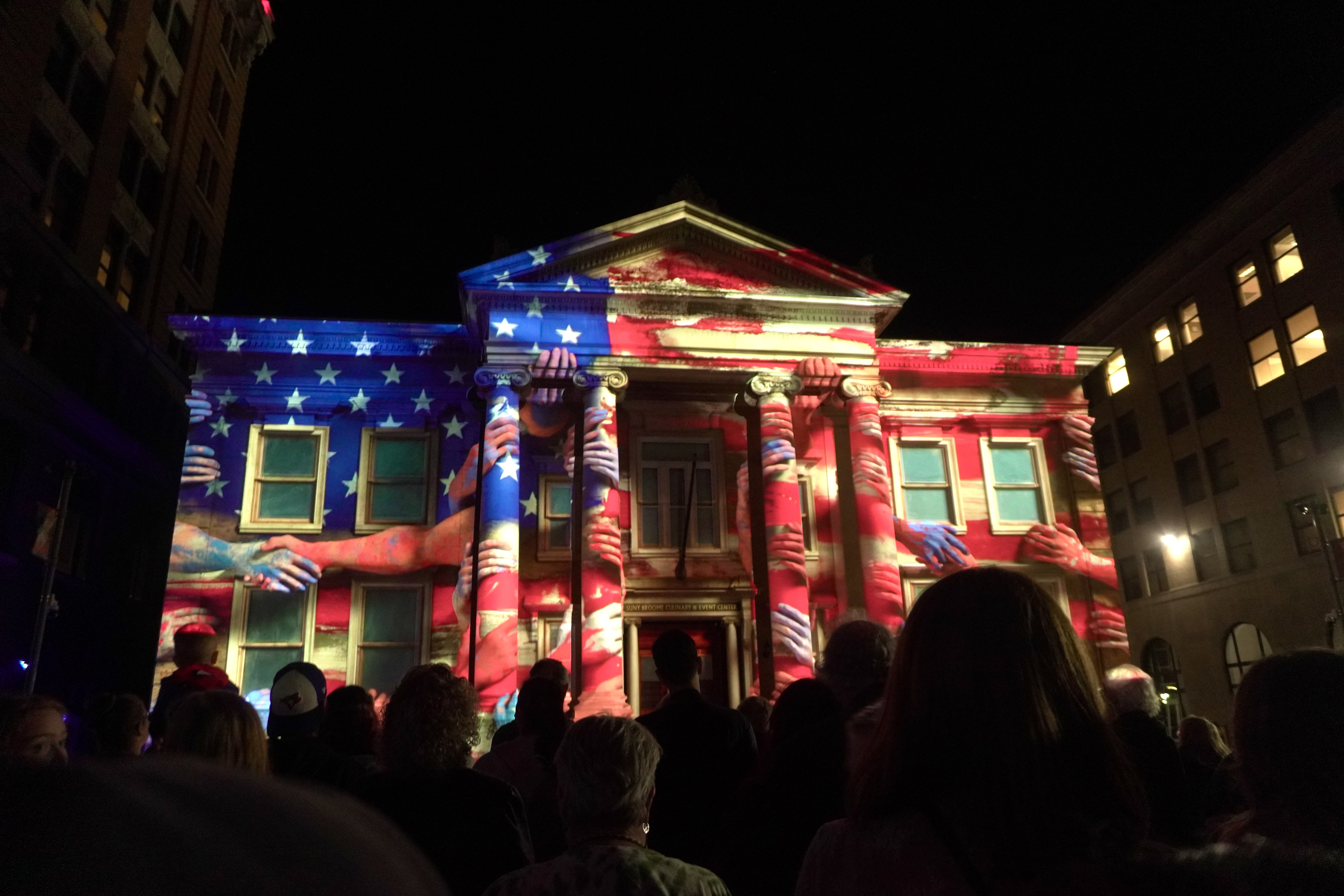
The LUMA Projection Arts Festival and eager crowds returned to Downtown Binghamton for its 12th-annual showcase, with eight major features and 10 small features for an immersive experience. The event took place on Sept. 11 and 12 and ran from 8:30 p.m. to 12:15 a.m., remaining mostly free to the public.
Originally founded by a street photographer, film editor and event planner, LUMA has merged the relationship between technology and space since 2015. Today, the festival continues to welcome artists and engineers to contribute to the impressive designs.
Centered around strategic projection mapping, light installations, 3D animations and atmospheric soundscapes, the festival uses downtown Binghamton as its very own canvas — transforming the city into a large-scale and mesmerizing outdoor gallery.
“City hall turns into a gingerbread house,” the LUMA website reads. “The courthouse becomes Stonehenge. The light overpowers the architecture and the effect seems real. Going to LUMA is like visiting some giant outdoor art gallery where the paintings tower over you 6 stories high. Enjoy it in any order you choose at whatever pace you like. You’ll find projection mapping, light installations, immersive live performance and something new every year.”
Several streets were closed off for fans to view the works, and food trucks, concession tents and craft vendors lined the streets. Hungry festivalgoers munched on snacks from funnel cake to turkey leg to macarons to beef patties. Others perused the merch table or admired handcrafted jewelry for sale.
This year, historic architecture was covered in animated landscapes, geometric patterns and bursts of color. Smaller installations brought their projection and light into more intimate spaces.
One of the festival’s major features, “Patterns in Nature,” by French artist Jérémie Bellot, used natural patterns consisting of swirling spirals and branching networks. He created a five-part immersive installation, combining mathematics, natural history and biology to analyze the invisible systems that shape the environment.
Other artists approached their works in a more experimental way. “In Medias Res,” created by Binghamton University Cinema graduates Brian Gray MFA ‘26 and Benjamin Stone MFA ‘26, used stereoscopic projection, shadow play, live animation, mechanized puppetry and video feedback. Their work was presented in anaglyphic 3D and took inspiration from experimental filmmaker Ken Jacobs, who co-founded the cinema department at the University, and his techniques.
The festival also showcased LUMA Small Works, a collection of 10 smaller installations placed throughout Downtown Binghamton. The program featured artists working within animation, abstract motion, performance and digital experimentation. Expanding the festival’s artwork, audiences were able to encounter works of art between the larger installations.
“Arboreal Canvas” by Diana Reichenbach, a piece highlighted in LUMA’s Small Works, received Best in Show at Digital Graffiti 2026.
“Arboreal Canvas investigates the tree as medium, allowing projected imagery to move across bark, branches, and foliage while the environment reshapes the visuals in real time,” the LUMA festival’s website stated. “Emmy Award–winning artist and educator Diana Reichenbach transforms organic surfaces into an immersive dialogue between digital image and natural form, using light, texture, movement, and depth to blur the boundary between animation, landscape and installation.”
LUMA also invited community participation through the Peg Johnston Living Lights Project, formerly called Mural Mapping. The project provided artists with drawings of historic buildings to be reinterpreted as paintings, collages and digital animations, and were then selected to be projected during the festival.
“The resulting high-resolution scans are then projected on building facades during the festival, creating an immersive gallery that bridges the gap between traditional and digital art,” the LUMA festival’s website stated. “This transformative project breathes new life into familiar structures, embodying the spirit and talent of the Southern Tier community.”
The festival received over 200 artist applications from around the world and had the highest number of small installations yet.
LUMA continues to bring streets to life as it welcomes international and local artists to Downtown Binghamton and provide emerging artists with opportunities to share their work while experimenting with the intersection between technology and art.