





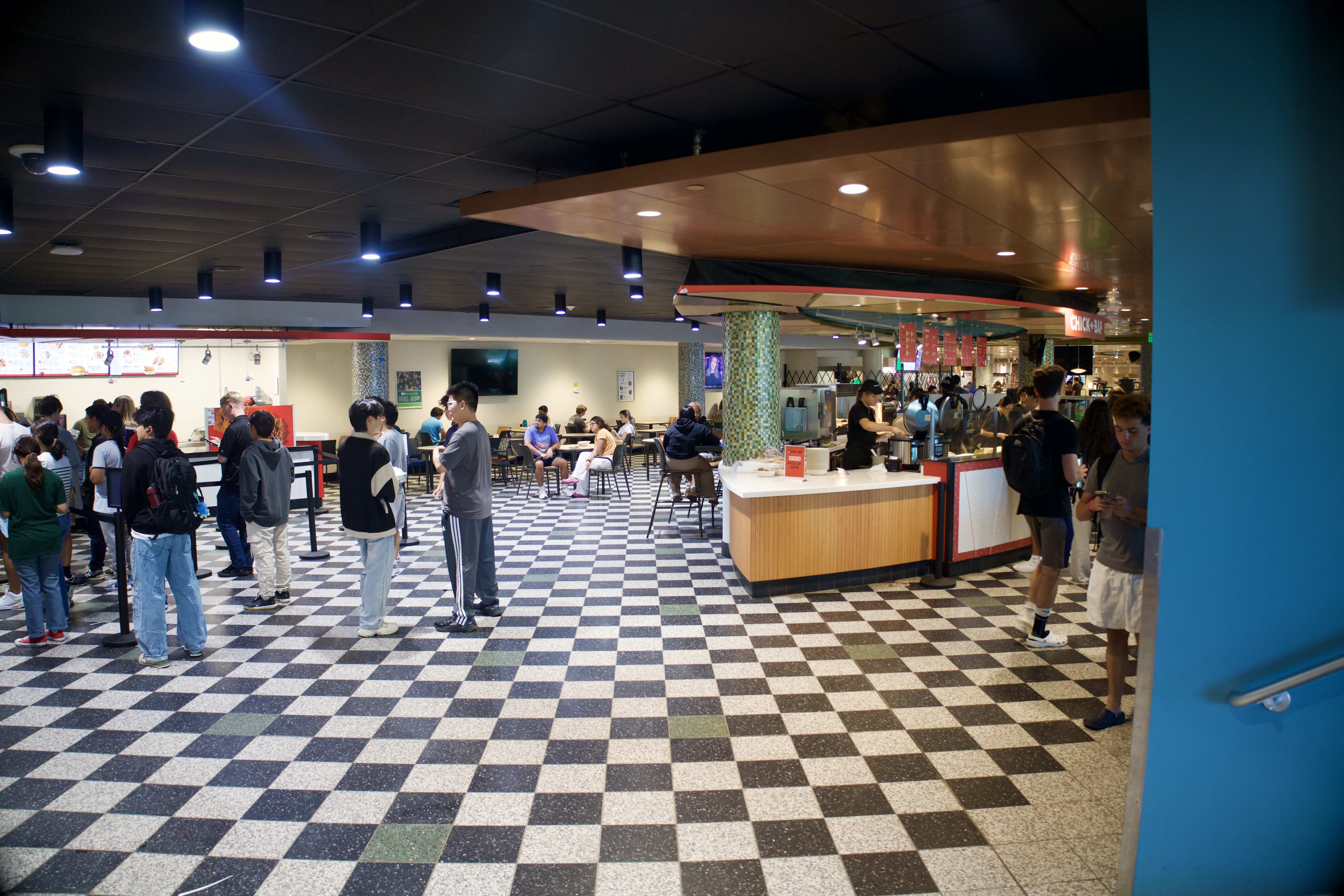
After 40 years with Sodexo as its dining provider, Binghamton University has made the change to Chartwells Higher Education.
The University announced it will not be renewing its contract with Sodexo in February, following student activism and concerns about food safety, and began its 10-year contract with Chartwells on June 1, 2026. Chartwells currently operates at more than 330 colleges and universities across the country.
“The launch of Bearcat Dining marks an exciting new chapter for campus dining at Binghamton University,” said Jeff Stone, district manager of Bearcat Dining with Chartwells Higher Education. “We’ve spent months listening, planning, and preparing for this transition, and we’re eager for students to experience the new dining options, expanded flexibility, and enhanced services available across campus this fall.”
Chartwells has introduced “Delicious Without” to all four dining halls on campus, a station that caters to students with allergies, gluten-free and free of the top nine allergens.
New dining options are available in the MarketPlace as well. The One Sushi has grab-and-go sushi rolls; B3: Breakfast, Burgers and Bites serves breakfast sandwiches and burgers; Fire & Rice features Asian-fusion food and bubble tea. Other recent additions include Leaf & Loaf, Enzo’s Pizza, Jamal’s Chicken, Halal Shack and District Pickle. Chick-n-Bap, Shake Smart and Royal Indian are still in the MarketPlace.
Ryleigh Dando, a sophomore majoring in global public health, told Pipe Dream that with prices being higher, the MarketPlace lines have gotten longer because the MarketPlace is comparatively cheaper than last year.
“The lines are so long that I’m deterred, and everyone is just there,” said Dando. “But then also, I feel bad for the staff that has to deal with not having enough food prepared.”
There is no longer a residential dining fee. Now, students can spend every dining dollar purchased. However, prices in the dining halls have increased to cover the cost of labor, which was previously covered by the membership fee.
Some students have enjoyed the dining changes, while others have reacted less positively.
“Maybe I just have high standards of food, but it’s not the most appetizing, and I was pretty disappointed,” said Kassidy Shyu, a sophomore majoring in psychology.
Shyu also expressed preferring the MarketPlace over the dining halls because the price is more comparable in the new system.
All four dining halls still include the grill, salad bar, deli and Bearcat Bakery stations. Stations added in the provider changeover feature noodles, pizza, Latin, Italian and Southeast Asian dishes.
“I feel like the biggest difference is the pricing,” said Molly Kantor, a sophomore majoring in political science. “It used to be super subsidized, and now I feel like it’s not really.”
For food options late at night, Bing After Dark is at Appalachian or Chenango Champlain Collegiate Center Dining Hall from 9:00 p.m. – 1:00 a.m.
“The food definitely tastes better,” said Erin Kreuder, a sophomore majoring in environmental studies.
“I like the accessibility of Grubhub, because I can use my dining dollars on it, and I can order ahead, like if I’m in class and just want to get a bite to eat,” added Kreuder.
Students criticized the previous dining provider, Sodexo, over affordability, accessibility and numerous health code violations. The Chenango Champlain Collegiate Center failed seven out of eight health inspections conducted since Oct. 23, 2020.
Envision Strategies, a food service consulting company, and the Binghamton Auxiliary Services Board led the selection process for a new dining provider. Chartwells scored highest in the evaluation of dining proposals for factors like technology, sustainability and inclusive dining options.
The University’s chapter of Young Democratic Socialists of America advocated throughout last year for this dining service change, having organized town halls in November addressing students’ concerns for safe and affordable dining options and organizing rallies.
“Binghamton YDSA won, through our collective actions, the end to membership fees and the increasing of options for people with certain dietary restrictions,” wrote the YDSA in a statement to Pipe Dream. “These are meaningful improvements to students’ lives. But improvement remains needed: truly gluten-free options, as opposed to ‘avoiding gluten’ options that leave students in the dark as to what is and is not safe to eat, are still needed on campus.”
“Additionally, Chartwells and the university still have large steps to take to build a fair food system on campus,” the YDSA continued. “Workers remain underpaid, and student workers remain un-unionised. The lack of meal swipes still risks people going hungry on campus. The Binghamton University YDSA continues to call for the increasing of the wage floor for all dining workers to 20 dollars and the adoption of meal swipes at all dining halls.”
Hatim Husainy, a junior majoring in political science, treasurer of the YDSA and candidate for BU Council Representative, told Pipe Dream that for the YDSA, there is still much to be desired.
“The transition has not given us all of our demands,” said Husainy. “But critically, the transition is not at this time complete. I am hopeful that as Chartwell continues to be able to wrap its arms around the whole of Binghamton’s food system, we can see even better changes from them, especially as we continue to pressure them.”
Bearcat Dining did not respond to Pipe Dream’s request for comment.