





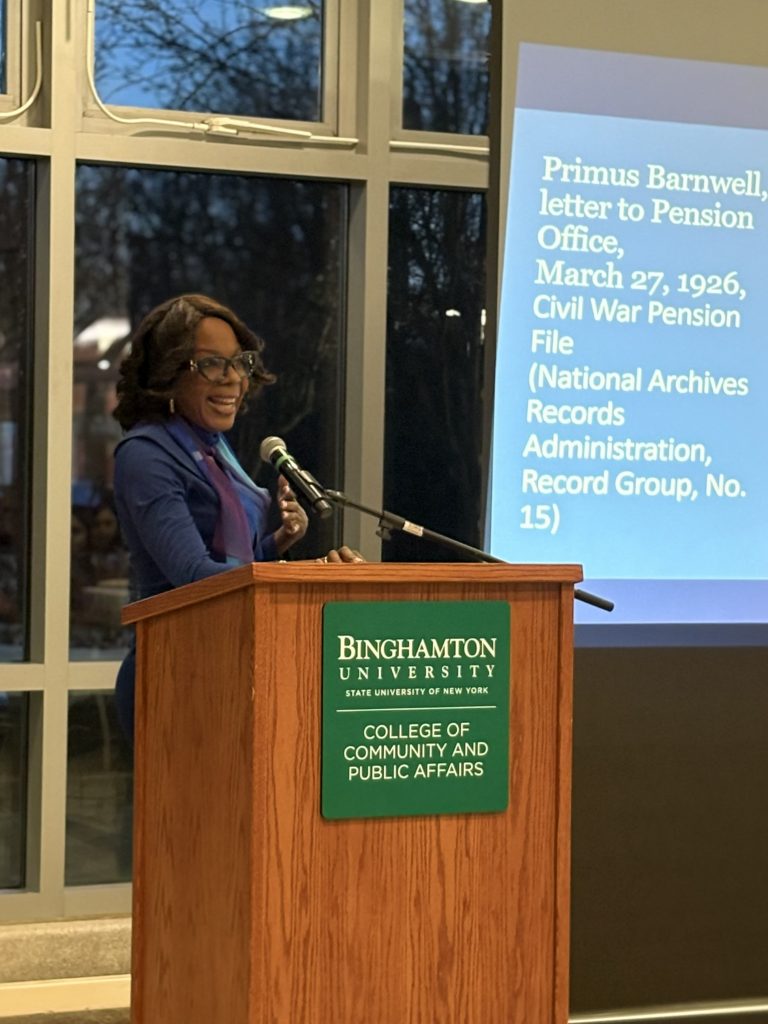
Pulitzer prize-winning historian Edda L. Fields-Black visited Binghamton University on Tuesday and delivered a lecture based on her most recent book “COMBEE: Harriet Tubman, the Combahee River Raid, and Black Freedom during the Civil War.”
Hosted by the Harriet Tubman Center for Freedom and Equity, students, faculty, administrators and community members packed into the University Downtown Center building to hear her deliver remarks. Student volunteers ushered in attendees and provided event programs.
Introductory remarks were given by University President Anne D’Alleva; Monica Adams, an assistant professor of social work; Diane Sommerville, a professor of history; and Anne Bailey, director of the Harriet Tubman Center and history professor.
“We talk about equity and diversity and inclusion as important principles, not only for our beloved community, but for the University community, for the SUNY system,” D’Alleva said. “Access, opportunity, equity, justice for all — this is our mission, this is what we do, and I’m so very grateful for the Tubman Center and the work that they do to lead that effort.”
Fields-Black is a professor of history and director of the Dietrich College Humanities Center at Carnegie Mellon University. She specializes in the history of rice farmers in West Africa, peasant farmers in the pre-colonial Upper Guinea Coast and the history of enslaved laborers working on rice plantations in South Carolina and Georgia. She aims to tell the stories of those who did not leave written narratives.
“I am a social historian and the history that I write is about people who are usually not in the official record, and they didn’t author sources,” said Fields-Black. “They were illiterate, they were marginalized and so you can’t just look at them in the usual places for their records. So I’m accustomed to getting my hands dirty and getting in the cracks and the crevices and looking in places that nobody else thought was important to look.”
She received numerous accolades for her book, including the 2025 Pulitzer Prize in History and the Gilder Lehrman Lincoln Prize. It tells the story of Harriet Tubman’s role in the Combahee River Raid and its broader effects on the liberation of enslaved people and the Civil War. In it, she argues that Tubman was deeply involved in the raid, and that the raid was “the largest and the most successful slave rebellion in U.S. history.”
The Combahee River Raid, which took place between June 1 to June 2, 1863, was a freedom mission carried out by the U.S. Army and the United States Colored Troops. Three gunboats carrying 300 USCT troops, the 3rd Rhode Island Heavy Artillery, Harriet Tubman and Colonel James Montgomery set off on June 1, one of which ran aground. The remaining two boats continued on and arrived at the entrance of the Combahee River early on June 2, where they encountered Confederate soldiers, who fled at the arrival of the Black soldiers. The raid continued, resulting in the destruction of seven plantations and the emancipation of over 750 people.
After the talk, Kathleen Sterling, associate professor of anthropology, opened the floor to questions from the audience.
Refreshments were served after the lecture and many attendees gathered for a book signing.
Fields-Black explained she had the stories of “three main characters” in mind while writing the book: Harriet Tubman, the freedom seekers and the rice fields and the environment.
While Tubman’s life is extensively documented, some historians had previously denied that she was involved in the Combahee River Raid, despite Tubman talking about the raid later in her life. Fields-Black aimed to “bridge that gap” in literature about Tubman.
She found that Tubman was deeply involved in the Combee River Raid, captaining men up the river along with Colonel James Montgomery. She also infiltrated Confederate plantations, worked in refugee camps in the area and stayed with the women and children during the raid while her men removed torpedoes from the river, allowing U.S. Army boats to pass through.
Fields-Black used U.S. Civil War Pension Files to piece together narratives of the Combahee River Raid. Previously, historians had two main sources to hear the stories of formerly enslaved people in their own voices — slave autobiographies and interviews conducted by the Works Progress Administration in the 1930s. Through the pension files, she was able to see personal histories and social lives of people who had been enslaved.
In searching through these files, Fields-Black encountered records of Hector Fields, who was on the lead boat with Harriet Tubman during the raid. Fields, she discovered, was her great-great-great-grandfather.
During her research, Fields-Black spent 18 months in residence at the Combahee, hiking through the rice fields and working with a team of scientists to map out plantations.
“I felt like I was on a mission,” said Fields-Black. “I felt like I had been put in this position so that I could tell this story, and that was why I was there. And so my emotions were really around that. I was able to see the remnants of the life that people in bondage on these plantations lived, and my role and my responsibility was to tell the story.”