





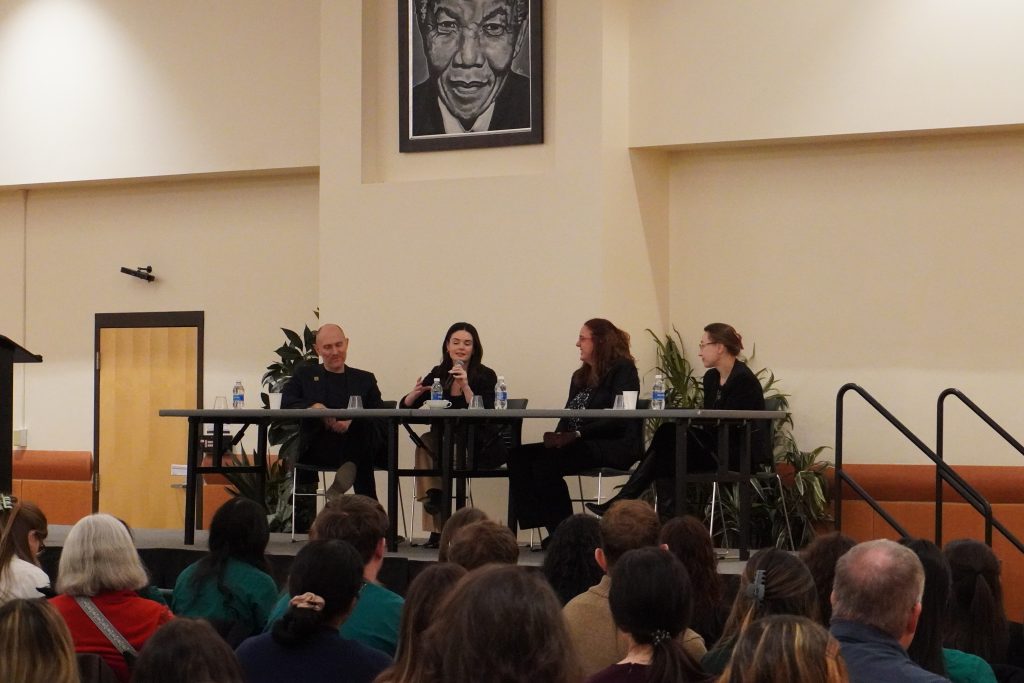
Hundreds of students and faculty from Binghamton University’s Decker School of Nursing gathered on Friday in the University Union for a panel discussion about the impact of artificial intelligence on the field.
Maxim Topaz, an associate professor of nursing and data science at Columbia University, was the keynote speaker at this year’s Roger L. and Mary K. Kresge Center Lecture, titled “Using AI to Advance Nursing and Health: Tools, Pitfalls and Practical Workflows.” Topaz leads a team of researchers that harness AI technology to improve patient care. Along with developing a unique open-source natural language processing software, his team introduced and tested a tool called PREVENT to help nurses identify home care patients at high risk for rehospitalization.
Focusing mainly on AI language processing, Topaz explained how this technology can help researchers compile and identify data from records and conversations between patients and nurses to better inform care.
“We build tools that read those clinical notes generated by nurses and then extract risk factors from those texts that we write,” Topaz said. “But when we write things about patients, we don’t just write things to just write them. We indicate important risk factors. And yes, our research has shown that those risk factors, if you extract them at scale, if you’re capable of doing that, then you can really improve risk prediction and identify patients at risk for poor outcomes in the hospitals.”
To explain how AI can be incorporated by nurses on the job, he offered a hypothetical example of a chief nursing officer who, while facing high staff turnover, is asked by the hospital’s board of directors to present an “evidence-based retention strategy” in only a few days.
By using Google Gemini and other AI programs, the officer can identify and evaluate current research on retention building, then build a targeted survey to pass around to the other nurses at the hospital.
“This technology has not been here three years ago — now, this technology can do such amazing, statistician-level, expert-level work,” Topaz said. “Sometimes it screws up badly, right? So you still need to know, you still need to be able to track what’s being done by those chatbots. But sometimes it amazingly does things correctly.”
Among the risks of using AI is that its outputs might be biased, a reality that heightens the importance of having nurses involved in the development of new tools, he added.
The pace of technological advancement has been fast-paced, Topaz said, with more than 30 percent of doctors in the United States using ambient AI to summarize and transcribe patient visits.
Following the keynote address, a poster session was held in Old Union Hall from 10:30 a.m. to 11:15 a.m.
After the poster session, a panel discussion and Q&A were held with Topaz and three other experts: Ann Fronczek, an associate professor and director of undergraduate and Ph.D. nursing programs for Decker College of Nursing and Health Sciences; Laura-Maria Peltonen, an associate professor from the University of Turku and Eastern Finland University; and Meghan Turchioe, an assistant nursing professor at Columbia University.
Turchioe shared her view that while AI will remain a useful tool to teaching nursing, it will not “replace the essential work” that students perform in clinical labs.
“It doesn’t matter how much you train AI on nursing, your nursing instructors have knowledge and applied expertise across decades that can’t really be replicated or reapplied right now by these models,” she said. “So that’s what we’re thinking about.”
The panelists also discussed whether AI technologies should be allowed to have access to patients’ medical records. Peltonen mentioned that the European Union has stronger regulations in place to guard individual and data privacy. The European Union’s Artificial Intelligence Act, for example, requires all AI systems used for medical purposes to comply with risk mitigation and human oversight regulations.
By contrast, the United States lacks similar AI regulation at the federal level. Individual states like California, Colorado and New York have passed laws regarding transparency and AI usage.
Students were given the opportunity to ask questions at the panel. One student asked the panel to consider some potentially negative aspects of AI on the environment. Turchioe responded by listing off previously discussed concerns about bias and inaccurate responses from the AI.
A different student asked the panelists to answer the question again and specifically focused on concerns related to AI and water usage. Topaz said that powering ChatGPT requires as much water as used when watching Netflix.
“We included junior and senior undergraduate nursing students and graduate nursing students at our 2026 Kresge Center Lecture because we want to give them the very best foundation we can,” said Mario Ortiz, dean and professor of Decker College. “We want to expose them to experts in various fields and challenge their thinking. In turn, our students brought their unique perspectives to the event and challenged us.”