





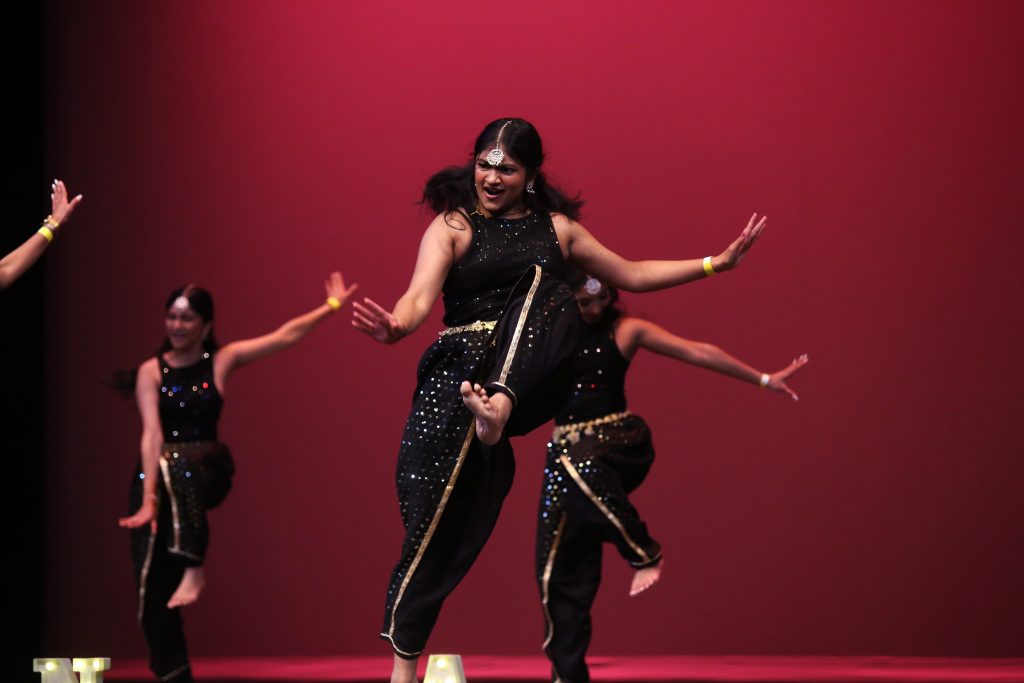
The Indian International Student Union showed out for its annual Tamasha performance, with dance and musical showcases highlighting South Asian culture. On Saturday at the Osterhout Concert Theatre, students and families came together to experience IISU’s largest event of the year.
This year’s Clue theme had members of IISU’s E-Board cast as the board game’s familiar suspects in a suspenseful murder mystery. Videos of scenes inspired by the game were played throughout the night so the audience could keep track of hints left behind.
The IISU was founded in 1986 by students seeking to preserve their Indian heritage and has since grown to represent all South Asian students. Hosting cultural events in collaboration with other multicultural organizations to both showcase and educate has become an integral part of their organization. Tamasha is an example of that, as it provides a space for students to feel a part of a community.
“We hope that people who watched Tamasha this year really took away just how special this event is for IISU as an organization and how passionate our general body is to display our culture to not only all of campus but to everyone from all over the East Coast who came to see our show,” Ashwathi Cheman, president of IISU and junior majoring in biology, wrote in an email.
The night kicked off with the freshman dance, presented by the freshman class of IISU to welcome guests to this year’s Tamasha. This led into the first interactive game of the night — the “rizz” contest. Audience members were called to the stage to interact with IISU’s E-Board and the audience voted who had the most rizz. Other interactive events throughout the night included musical chairs and an improv competition in which audience members performed overdramatic skits.
Following that came the anticipated performance from Binghamton Bhangra, a co-ed competitive dance team founded in 2006. Bhangra is a traditional Punjabi folk dance often accompanied with beautifully bright colored costumes and dynamic dance moves — highlighting the diverse student body on Binghamton’s campus.
Then came the classical dance rooted in Bharatanatyam and Kathak, which embodied narratives with intricate hand motions, spins and various footwork. Both of these styles date back well before the common era and have been preserved through thousands of years. Together, they tell the ancient stories of Hindu mythology in the modern day.
Quimbamba Latin Dance Team and the Black Dance Repertoire performed two electrifying routines. Both groups draw inspiration from African dance, with BDR performing jazz, reggae, Latin, modern, African and hip-hop and Quimbamba performing dance styles like merengue and reggaeton.
Next, members of IISU performed a hip-hop routine, dressed in jeans and jerseys to contrast the lehengas from earlier performances. The performance mixed popping and stepping with modern dance styles to showcase the global nature of hip-hop.
In the spirit of blending Western and South Asian inspiration, Bollywood Film and Bollywood Beats performed routines depicting the experiences of growing up in two unique cultures.. Inspired by the hit movie “10 Things I Hate About You,” Bollywood Film mixed well-known plot points with dance breaks in the same style as famous Bollywood movies. Bollywood Beats, an a capella group, performed covers of popular English pop and Hindi songs.
Binghamton Masti and Adelphi University’s Sapna, both South Asian fusion dance teams, combined traditional dance styles with hip-hop and jazz. Alina Tharian, president of Masti and a senior majoring in industrial and systems engineering, expressed her gratitude for time she has spent with her team.
“My experience at Binghamton would not be the same without IISU and Masti,” Tharian wrote in the event program. “I’m so lucky to know all these amazing, talented dancers and Tamasha has always been a great outlet for me to do what I love. It’s also allowed me to spread my culture with my non-Indian friends and I’m so grateful that every single year I have an amazing crowd of friends who show up and cheer me on.”
Leaning into cultural roots came a traditional Garba performance and the South Indian Dance. The first dance incorporated Garba-Raas, a folk style originating from Gujarat, India that usually honors the Goddess Durga. The South Asian Dance focuses primarily on the regions of Kerala and Tamil Nadu.
“Tamasha has definitely grown tremendously throughout the past couple of years, from being a small showcase in Mandela to one of the largest stage productions hosted by a cultural organization at Osterhout Theater, which IISU takes a lot of pride in,” Cheman wrote. “Tamasha in itself is a celebration of the diverse art and entertainment forms of South Asia but also invites the audience to so many cultures worldwide.”
Closing the show came the senior dance and slideshow, which highlighted the seniors from all participating organizations. With one final dance, the seniors celebrated for all their time spent with their organizations.
The final act included a fashion show that displayed modern Indian fashion. In a tearful close, the E-Board of IISU took to the stage, highlighting their work as organizers. Rhea Kemshetti, senior advisor for IISU and a senior majoring in integrative neuroscience, reflected on her time spent with the organization.
“One of the best decisions I’ve made in my college career is joining IISU,” Kemshetti wrote in the event program. “I originally joined because I wanted to feel more connected to my culture and find balance, but then I realized that IISU is just one big family. Being able to host Tamasha and support people who I consider my brothers and sisters has been such a moment of purpose and if I were to do college over again, I wouldn’t change it for the world.”