





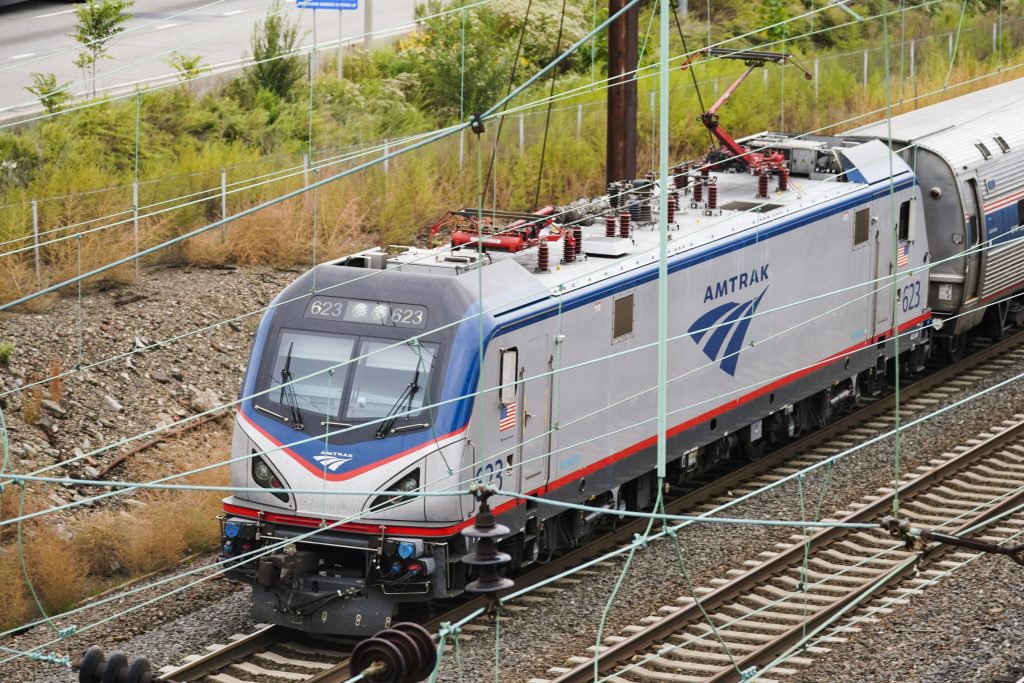
In a recent mayoral debate, Mayor Jared Kraham said his administration was exploring ways to implement passenger rail service in the Greater Binghamton area.
During the debate, hosted by the League of Women Voters of Broome and Tioga Counties, both Kraham and his Democratic challenger, Miles Burnett, discussed public transportation and said they would be open to a potential Amtrak station in Binghamton. However, as Kraham acknowledged, train service would not hypothetically be available in the city for years.
Kraham said his administration is planning to apply for a Corridor Identification and Development grant through the Federal Railroad Administration, an agency within the U.S. Department of Transportation, to study the project.
“Passenger rail service here could fundamentally revitalize our local economy and deliver a service residents and elected officials have been dreaming about for decades,” Kraham wrote in a Facebook post. “Binghamton must join other communities, like Scranton, in taking advantage of new smaller federal grants to study passenger rail.”
In the post, Kraham wrote that the city plans to hire a firm to assist them in applying for a Corridor ID grant, which will be the first step in the process of bringing passenger rail service to Binghamton. If an application is approved, the city could be awarded $500,000 to cover some initial costs, “including the development of a scope, schedule, and cost estimate for preparing a service development plan.”
In a statement to Pipe Dream, Kraham said a passenger rail service would improve residents’ quality of life, make the city “more attractive to young professionals and employers” and allow for increased tourism in the area. At the debate, he pointed to the proposed Amtrak line connecting New York City to Scranton, Pennsylvania as an asset to a potential station in Binghamton.
“The fact that Scranton has access to New York City and vice versa through a Corridor ID, and that route has been identified, means we just have to get from Binghamton to Scranton to restore, eventually, rail service between Binghamton and New York City,” Kraham said. “If completed, and again, this is something that’s probably a decade plus in the making, that could transform our local economy. It could open up opportunities for growth.”
Scranton is in the final stages of building the Amtrak line. PennDOT, Pennsylvania’s transportation department, announced that after receiving the Corridor ID Grant, the department has moved toward completing a railroad connecting Scranton to New York Penn Station.
An Amtrak representative told Pipe Dream that “the mayor would have to reach out to NYSDOT to coordinate on a potential Corridor ID application” to accomplish the establishment of a passenger rail line in Binghamton.
Binghamton was once home to a passenger rail service with stops in New York, Pennsylvania and New Jersey. Built in the early 1900s, the historic Erie Lackawanna Train Station was active until 55 years ago, with the last train leaving the station in 1970. Located in Downtown Binghamton, the old train station was recently converted into a steakhouse, Station 45.
In a statement to Pipe Dream, Burnett claimed that Kraham’s announcement was “designed to create headlines during an election” and that he should have applied for the grant earlier in his four-year term.
“Rather than celebrating that my opponent is finally submitting an application, he should answer for why the city has not made critical investments in transportation alternatives to assist people in our community in getting to the places they need to go,” Burnett said.
In August 2023, Kraham’s office released an over 900-page report that concluded a majority of railroad bridges in the city are in poor or severe condition. The majority of railway overpasses in Binghamton are owned by the private railroad giant Norfolk Southern.
That August, the company announced it would begin repairs on seven of its bridges.
Burnett said that while he is open to an Amtrak station in Binghamton, he would also focus on investing in local transportation if elected as mayor.
“This won’t happen quickly, and the city ultimately won’t be the lead agency,” Kraham wrote on Facebook . “But Binghamton should act boldly and proactively to spark the process. It would be the first step toward building a coalition of local, state and federal partners to support smart, sustainable rail investments that can drive economic development across the Southern Tier.”