





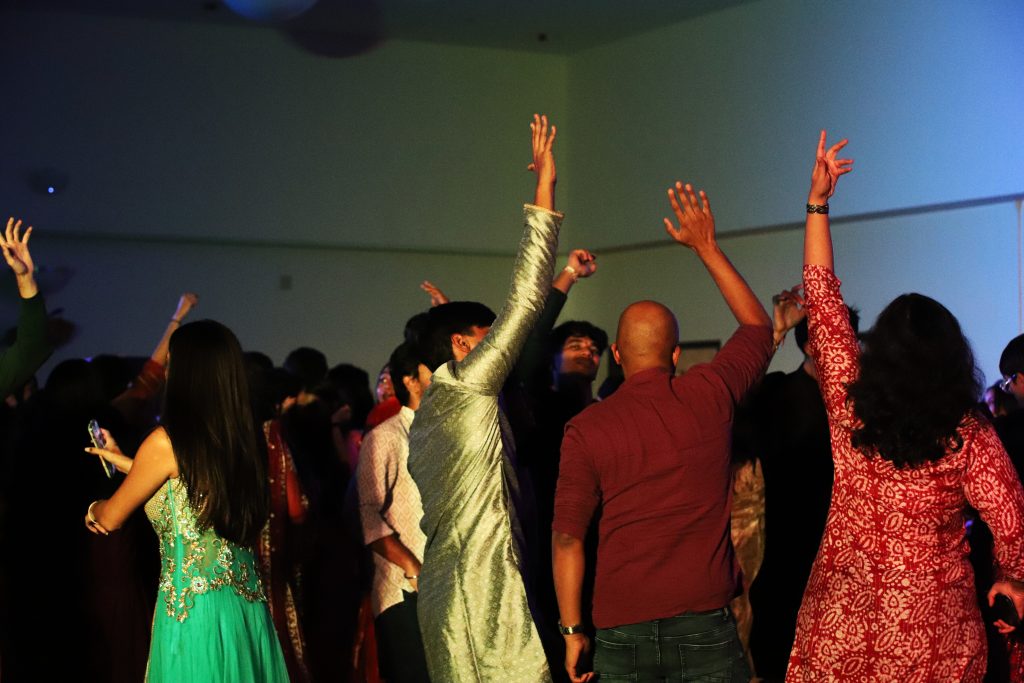
The Hindu Student Council held its largest event of the fall semester on Sunday to celebrate Diwali. With the help of Binghamton Bhangra and attending guests, the evening consisted of lively conversation, a short presentation on the significance of Diwali, dances, a game and dinner.
Upon walking through the golden streamers hanging from the entrance, the Hindu Student Council welcomed guests into the Mandela Room, which was decorated in purple and yellow colors and fairy lights, with an array of circular tables scattered across the floor. A projector was placed at the front of the room, along with a small stage lined with mini parasols. Yellow lights projected over the stage, along with dim overhead lighting to the scene and two large speakers playing enjoyable background music.
For the first 45 minutes, people situated themselves at tables and joined in conversations around the room. The first event of the night consisted of a coordinated dance by the Hindu Student Council’s E-Board. They performed for the first time this year and the crowd seemed just as ecstatic as they were, clapping to the beat and cheering delightedly. Directly following the dance was a presentation on the significance of Diwali.
Reet Kampani, vice president of the Hindu Student Council and a senior majoring in accounting, described the council’s goal for guests attending the event, which is reflected in their presentation and the months of hard work they put into depicting the celebration’s cultural depth.
“Our goal is for attendees to leave with a deeper understanding and appreciation of Diwali’s significance, which isn’t simply a ‘festival of lights’ but also a major celebration of unity, renewal, and inner reflection,” Kampani wrote in an email. “For many students far from home, this event recreates a sense of belonging and tradition on campus. We want everyone regardless of their background to feel welcomed and to experience joy and the richness of Hindu culture through this celebration.”
During a brief intermission from the performances, the Hindu Student Council hosted a small scavenger hunt where six contestants were selected from the crowd and competed for a gift basket. The last person to bring the hosts the object they asked for was eliminated, until one person was left standing and declared the winner.
The Binghamton Bhangra dance team performed next, with an enthusiastic energy that built a lively atmosphere. Tejasree Narisetty, a sophomore majoring in philosophy, politics and law and the organization’s public relations chair, described the significance of performing for an audience during celebrations.
“Bhangra is a Punjabi folk dance hailing from the northern regions of India and Pakistan,” Narisetty wrote in an email. “The dance is typically performed on special occasions as a form of celebration. Bhangra itself does not have any specific ties to Diwali religiously, however it is a cultural norm to entertain people attending large events with dance performances.”
“We perform so our audience can appreciate the rich cultural significance of Indian holidays,” she continued. “We aim to entertain and educate communities and students in Binghamton through our performances, hoping that our hard work helps people appreciate our beautiful culture.”
After another lively and entertaining dance, the crowd settled back into conversation and awaited dinner. There were a variety of options for the guests to indulge in, including dal makhani, aloo gobhi, paneer tikka masala and gulab jamun.
“Food holds a special place in Diwali celebrations for Hindus as sharing a meal together symbolizes prosperity, community, and gratitude,” Kampani wrote. “This year, the catering is done by Royal Indian, a local restaurant at Binghamton known for its South Asian cuisine.”
Pranshu Desai, a first-year graduate student studying industrial and systems engineering, attended the Diwali banquet as a guest and also assisted one of his friends with planning some organizational details for the event.
Desai reflected on the importance of valuing different cultures and appreciated the sense of belonging that HSC strived for guests to experience through campus events like the Diwali banquet.
“I had really low expectations coming to the United States, and I was not expecting this much culture and I was okay with that, but it surprised me,” Desai said. “They really celebrated vividly. And even the locals are like ‘Oh, tell us about your culture.’ They are really curious, and they really enjoy it.”
The banquet brought the community together in celebration, laughter and amusement as guests honored the important cultural and religious values of the traditions of Diwali.