





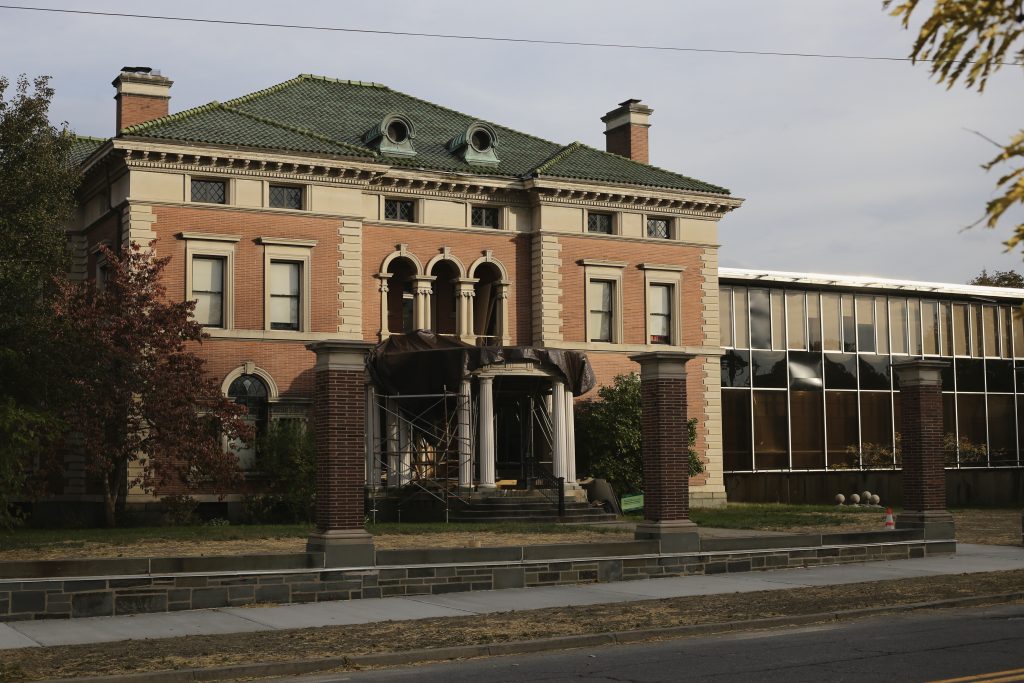
Among the model trains, 19th-century furniture and educational wall text on the tribes of the Haudenosaunee, there is a different presence within the galleries of the Roberson Museum. While centralized in a gallery on the second floor, artist Rich Harrington’s show “LIMINAL SPACES: a visual memoir” roots itself throughout the museum, stretching from the gift shop into the historic Roberson mansion, impossible to miss and even harder to ignore.
Each marked by a rainbow “H,” the artworks included in Harrington’s show infect the space, less in the way that disease can incapacitate and paralyze the body, but the way that a giggle can build to a guffawing chorus. The show is as much about the space it occupies and the visitors’ experience as it is about the art itself, creating the spaces of transition that Harrington gets the exhibition’s title from.
Transition is a central theme of the exhibition, connected to the metaphorical and physical sites of change — mostly childhood — that are the subject matter of most of the individual artworks in the exhibition, like the first day of school, a Cub Scout trip, Easter Sunday and a Twister mat.
The exhibition spans mediums as much as it spans the Roberson Museum, using multistep processes and found objects to create works that utilize the imagery and narratives of Harrington’s childhood “to [reassign] and [recontextualize] them to create another narrative that also existed but was not acknowledged.”
Several works are painted images from childhood photographs taken by Harrington’s mother, alternately vividly ’60s Technicolor and stony grey and white. Others include a loop of home movies, transferred images on square segments of a Twister mat, larger-than-life sculptures of a paper doll family and intimate imaginings of puppets and reconfigurations of children’s dictionary images.
The paintings are near flawless and match the mass-produced castoffs from your childhood bedroom, all meant for this Island of Misfit Toys. The triptych “Queen of Jacks” is first seen from a distance at the entrance of the museum and appears to be the standard design for a 52-card deck. However, as viewers get closer and stay with the works, it becomes apparent that they are anything but.
A play on the term queen for effete gay men, the cards each include the image of a man bedecked with gay symbolism. The patterns slowly reveal themselves to viewers, and some may not be understood by every person who sees them. Luckily, that is not the intended effect, and Harrington cleverly avoids over-explanation that would dull his imaginative works that seem ready to burst. The meanings of the sprigs of lavender held by one queen and the sash of pansies on another card are not immediately recognizable, and thus, according to Harrington, “challenges viewers to see queerness as both visible and integrated into everyday experience.”
By displaying paintings like these throughout the museum, Harrington concentrates his more experimental and experiential works in one gallery and allows for chance encounters with pieces like “First Day of School,” “Richy Jumps for Joy” and “Boys! Men!” that pull viewers in. This spread-out, all-over-the-space organization shows the possibilities of bringing contemporary queer art into historical museums and sites that do not immediately seem to correlate.
Harrington’s works function in the various galleries and rooms of the Roberson on their own and in conversation with other things on view. They bring a sense of humor and levity to what otherwise can seem like a slightly grim and dim early 20th-century historic museum.
“Butt Totem,” a sculpture made of found mannequin display forms from a closing Macy’s, is a surprise to visitors when they walk into the room and inevitably inspires some chuckles. The effect of these stacked butts is heightened when viewers turn around to look at what’s on the two half walls in front of the sculpture, and see paintings on either side of two extremely 20th-century looking white men who are trying to look anywhere other than the sculpture. The works cleverly play upon the space, and the comedy that Harrington creates in spaces and encounters like this breaks up the uneasiness that one picks up on at certain moments, of the distance a young gay child has from the dominant, heteronormative culture.
The show is a taut exhibition, with a fairly limited set of works that, dispersed throughout the museum, inevitably leave you wanting more. There is obviously a lot more that Harrington can do with found objects than what is seen in this exhibition. A participatory element made a small appearance with “Direct Instruction” that could have been elaborated on to heighten the themes of performativity that the artist draws upon.
The humorous use of the iconography and tropes of Harrington’s ’60s and ’70s childhood in Binghamton, as well as some time at the Maryland Institute College of Art, creates the aura of a more family-friendly John Waters for the visual arts. At the Roberson Museum, you can’t miss Harrington’s art — it’s harder to ignore, and even more difficult to forget.