





This year marks the 50th anniversary of Herizon, a lesbian social club and bar that was active in Binghamton from 1975 to 1991.
Herizon served as a women’s space and creative hub for Binghamton University students and locals alike. The club was known for its annual New Year’s Eve celebrations and frequent poetry readings, plays and performances by women artists and local bands. Regardless of the activity on a particular night, Herizon provided a space for women and lesbians.
“Looking back, I completely appreciate it,” said Dorian Zahka ‘86, who joined Herizon in 1984. “I was really just ushered into — I mean, everybody was, but being the age that I was, I was just really ushered into a community that was very creative, and just women from all walks of life, and smart. It was a really nice way to come out.”
In 1973, when Laurie Ryan, one of Herizon’s founders, began her time at the University, there was a notable queer presence in the local community.
“There were these huge plywood planks covering some building that was going up, and in lavender spray paint was written, ‘We are everywhere,’ ‘Lesbians unite,’ in these huge letters on this plywood,” Ryan said, describing what she saw on the University’s campus. “And I thought, ‘I’ve come to the right place.’”
Ryan met many of Herizon’s other co-founders at the Green Onion, a local lesbian bar. Less than a year after it opened, the bar was destroyed by a bomb reportedly set off by one of the owners for “financial reasons.”
Following the bar’s closure, Ryan read an article in a local newspaper about Peg Johnston, a woman closely involved with a lot of political organizing in the city. They eventually began a relationship.
“I just tried to worm my way into her heart, and I did, and we started going out with one another,” said Ryan.
Johnston suggested they start their own lesbian bar and social club. They pitched the idea to other lesbian students and community members, selected club officers and found a location — 77 State St.
Transforming the location into their ideal woman’s space was a group effort. They worked together to get a refrigerator, a bar top and chairs. One early Herizon mailer proclaimed that the price of membership was just $15 and a chair.
On New Year’s Eve in 1975, Herizon held its opening party.
“People had never seen anything like this,” Ryan said. “I mean, we were just blowing each other’s socks off all the time, and we were very interested in having a variety of entertainment. We had movie nights and we had game nights. We had women coming in and doing short plays.”
The club almost exclusively played music by female artists, and Ryan and Johnston became Binghamton’s distributors for Olivia Records, a record label founded in 1973 by lesbian musical and political figures. The connections they made through Olivia Records provided Herizon with access to live performances from artists.
In January 1982, the Binghamton Police Department’s vice squad shut down Herizon for selling liquor without a license and arrested four members, including Ryan. In the years that followed, Herizon bounced between locations. They still held some events at 77 State St. without selling alcohol, but they also gathered at the local Unitarian Universalist Congregation basement while searching for a new home base.
Two years later, the club’s 213 State St. location opened. As per Herizon tradition, it opened with a New Year’s Eve party to usher in 1984 and Herizon’s second generation.
At the height of the Reagan era, the club, onsite at least, remained largely apolitical and included a few conservative members. Outside of 213 State St., however, many Herizon members were involved in local and national activism.
Much of this was led by Johnston, who was also the executive director of Southern Tier Women’s Health Services, a local abortion clinic.
“Most of us worked as clinic escorts,” said Bonnie Morris Ph.D. ‘89, a Herizon member who arrived at BU in 1983 as a women’s history Ph.D. candidate. “We were very supportive of [Johnston]. She was the most powerful woman in town, no question.”
ohnston founded the National Coalition of Abortion Providers and co-founded the Abortion Care Network. She also played a large role in publicizing and fundraising for Herizon and participated in the club’s more creative endeavors.
By the mid-1980s, Herizon had hundreds of members, some in Binghamton and some who traveled from elsewhere upstate to attend events. Herizon hosted a campout every June, a Passover Seder and gay movie nights. They also sent out a monthly newsletter to all members.
When asked why the bar eventually shut down in 1991, opinions varied. Some said lesbians felt safer at other bars than they previously did, while others pointed to the drinking age being raised to 21.
“The money started to disappear, and we just weren’t bringing it in,” said Morris. “I tape recorded one of the last meetings we had — we had to vote about, ‘Can we survive if we’re not bringing in this kind of dough?’”
Following the bar’s closure, former members worked to keep the club’s memory alive. Herizon signs, newsletters and other materials have been displayed in the National Museum of American History and the Smithsonian.
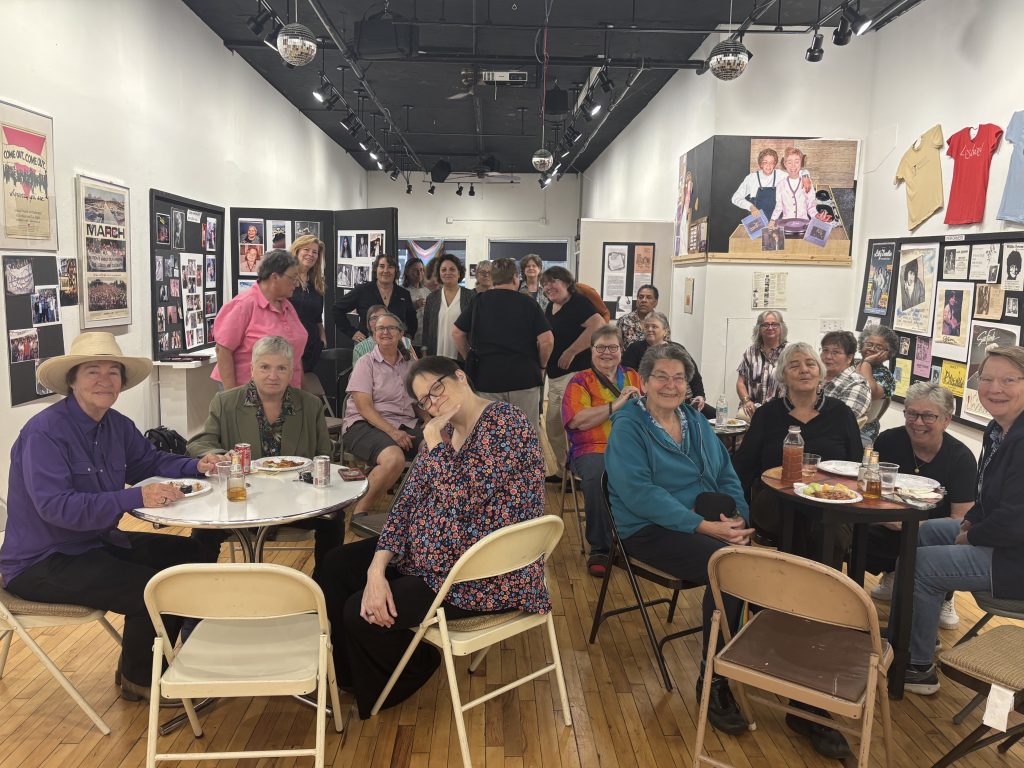
On Sept. 13, members reunited for the “Herizon’s Back in Town!” art exhibit at the Cooperative Gallery at 213 State Street, Herizon’s home from 1984 until its closure.
The 50th anniversary reunion saw Herizon members flock from across the country back to Binghamton. The gallery showcased artwork by members Judy Salton and MaryRose, photographs of Herizon events and other memorabilia, including t-shirts, event flyers and mailers.
Also included at the event was a memorial for members who had passed away, including Johnston, who died in 2023 at the age of 74.
Members reminisced and shared stories from their experiences at Herizon. For some, this was their first time meeting, as many of them had only been a part of one Herizon “generation.” Herizon had a lasting impact on members’ lives as a space filled with creative women, as many have written books and songs, created artwork and even filmed documentaries about their time at Herizon.
They also discussed the current state of lesbian rights in the local community and the United States.
“It’s a lot of years of fighting, and what’s sad about politics today is, we did this fight,” said Mel McNair, a Binghamton local and member of Herizon’s first generation. “We did this fight for years, and are we going to have to fight again? And so we’re all sitting around hoping not. It is scary, but you know what? We don’t give up fighting. No matter how old you are. You don’t give it up.”