





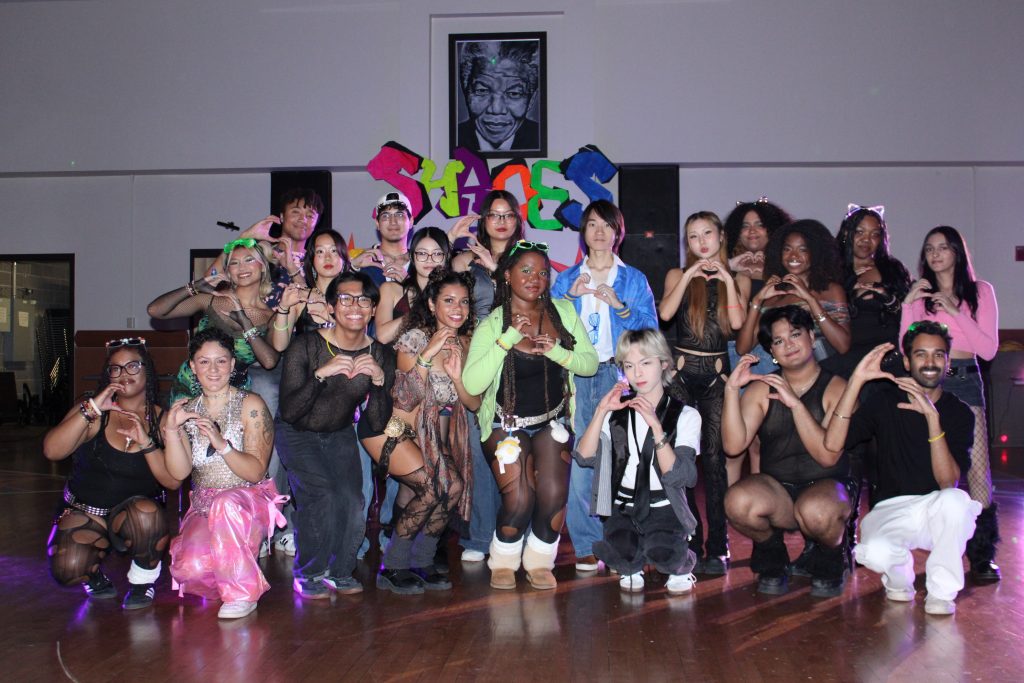
Fluorescent streamers cloaked the entrance to the Mandela Room on Saturday as the SHADES Vogue Ball 2025 lit up the night. SHADES describes itself as an LGBTQIAP+ organization at Binghamton University created specifically for students of color.
The theme, “Flashbang,” was an ode to the 1980s and the rave scene. At the entrance, attendees were given glowing sunglasses and colorful pamphlets detailing the order of performances and the history of the dance styles.
Ballroom culture and voguing were the backbone of the event. Ballroom-drag culture dates back to the 1880s and was often stigmatized and kept hidden, but with the help of LGBTQ+ representation and pop culture, ballroom is now open to all. Voguing is a personalized style of dance from the ballroom scene, which celebrates unique fashion, personalities and performances. It originated in Harlem and has roots in Black and Latino LGBTQ+ communities.
“Vogue Ball is a tribute to ballroom culture, which came up in the ’80s in New York City and was essentially a space for Black and brown LGBTQ people,” Ayman Habib, event coordinator for SHADES and a junior majoring in computer science, said. “It was their space. They had no spaces, so they made one for themselves.”
The room was set up like a runway with a boombox-like DJ booth, complete with matching SHADES lettering. A mirror selfie station with pop art signage served as a popular photo-op, along with a splattered glow-in-the-dark backdrop. Attendees mingled, sipping on drinks from the mocktail menu with stylized names like “Bass Drop” and “Flashbang.”
DJ Judd Espejo, president of RENA fashion magazine and a senior majoring in business administration, played an exciting set of club music throughout the night. Student fashion was the star of the show, with glittery boots and extravagant tops flashing under the low lighting. Through the sea of stylish students, emcee Kanaan Distant, a junior majoring in music, introduced the E-Board. Distant then explained how ballroom is a safe space for queer people to seek refuge and find a home together in performance.
The first group to take the stage was MajorNoir, the University’s only HBCU-style majorette dance team. The group entered in glittering silver leotards and their routine included popular hits such as “Vogue” by Madonna, paying homage to the night’s theme. They often danced directly in front of attendees, drawing them in for a night of audience participation. After their choreography ended, each dancer peeled to the side out of line, exiting in a swaying strut to cheers.
Next was the highly anticipated duo, Jhenè Vega and Jay Valentino, New York City-based professional performers with backgrounds in ballroom. Screams filled the Mandela Room as they entered from opposite sides, meeting in the middle of the floor. Amid drops, backbends and tumbles, they worked off each other’s moves to create a conversation in dance. Their stunts drew gasps from the audience and the final drops created thunderous applause.
Vega and Valentino invited volunteers to the floor, introducing what Vega called a “Vogue Hot Potato.” Audience members chattered excitedly as they created a circle. Participants would personalize their voguing, then pass the attention to another dancer by pointing.
The audience clapped along to the beat while Vega provided live commentary and hyped up the participants. Valentino was the final dancer, then volunteers caught their breath and made their way back to their seats.
The ball had four categories of Vogue styling competitions: Ultraviolet Realness, Rave Trade, Kandi Kween and Divine Glow. Each category brought out different dancers with corresponding outfits. As categories began, three judges decided who stole the show and awarded them with a trophy. Fierce dance battles were brought to the floor.
For Grace Johnston, a sophomore triple-majoring in French, linguistics and art history, entering the category Ultraviolet Realness was somewhat spontaneous but rooted in admiration for Ballroom culture.
“Vogue is not something I’ve experienced as a person who grew up [in] Upstate New York,” Johnston said. “It’s just such a beautiful part of the queer community, paying homage to the Black and brown trans elders we have as a queer community, just trying to pay respects.”
Johnston, vice president of the Rainbow Pride Union, explained how the organization often shares events with SHADES. She won the trophy for her category and raved about the performances that had already occurred.
“MajorNoir, they were incredible,” Johnston said. “I’ve never seen any of these groups before, and they were just so in sync and they had such a captivating energy. They were making eye contact with all of the audience members.”
Vega and Valentino performed a total of three times, each time with different outfits. Whether Vega was in heels or barefoot, her twirling acrobatics were incredibly impressive. Valentino performed in a beanie pulled over his eyes, performing and leaping blind. The audience gasped at this feat as the judges waved glow sticks.
The Black Dance Repertoire was dressed in ’80s-style workout clothes, sporting prop weights. Highlighting the ’80s-inspired “Flashbang” aspect of the theme, they used songs like “Physical” by Olivia Newton-John. “Milkshake” by Kelis was later played, and the audience erupted as the BDR showcased the viral choreography popularized by the musical group KATSEYE.
Kalea Andrews, a sophomore majoring in philosophy, politics and law, served as the costume chair on BDR and explained her involvement with Vogue Ball.
“We wanted to go for more of a workout ’80s vibe, since it was ’80s ‘Flashbang,’ we didn’t really want to go the rave route,” Andrews said. “So that’s why we went for the workout, colorful, neon. And song choices — we used one Vogue song just to appeal to the audience, and the rest was mainly ’80s.”
Andrews went on to win the final Voguing competition, Divine Glow. The Collision dance team was the last group to take the runway, absolutely electrifying the audience with their high-energy finale. Dressed in black, each member had their unique sense of style on display with their hip-hop focused dances.
Habib was also front and center as a member of Collision. While he brought energy to their performance, he also played a major role in organizing the Vogue Ball.
Habib described how the subcultures of raves correspond with the many facets of ballroom style and how the two aspects of the theme show all the different colors of the LGBTQ community at Binghamton. He shared his powerful vision for attendees and performers alike.
“I hope everyone just breaks out of their shell,” Habib said. “Especially because there’s a lot of audience participation segments of Vogue Ball. Not everyone’s a professional performer, but just taking that jump to put yourself on the stage, and show everyone, ‘I’m here and I’m queer,’ or whatever you are, just showing who you are. Especially with everything going on in the world, it’s just so important to make sure we’re making it clear that we are here and we’re not going away.”