





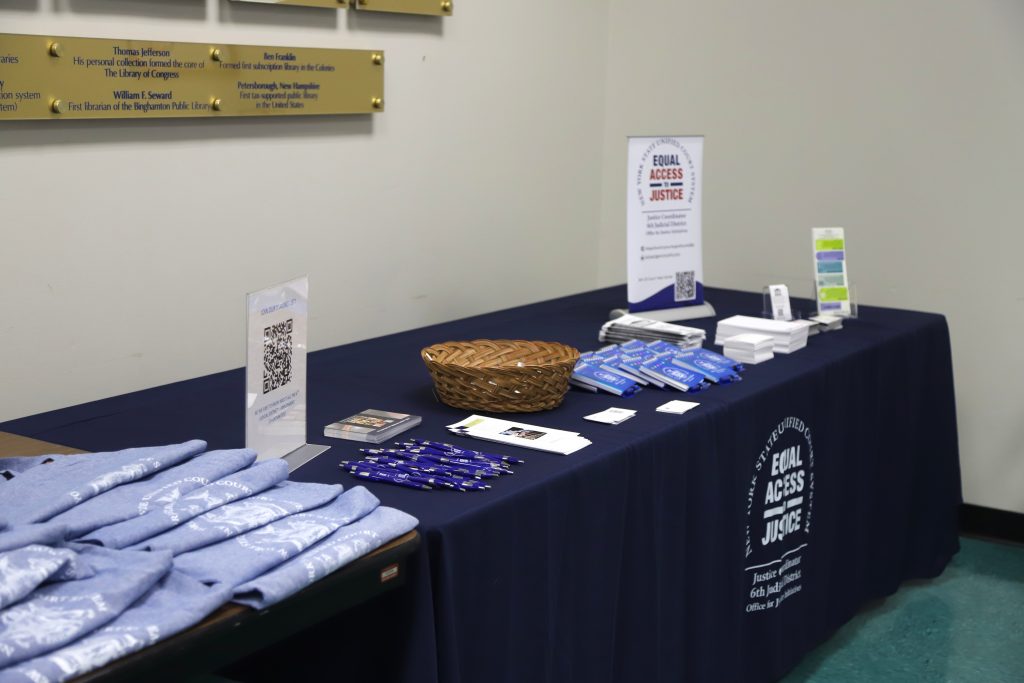
Local residents gathered at the Broome County Public Library last week to learn more about legal resources and how the court system is addressing community needs.
Administrative Judge Eugene Faughnan and District Executive Porter Kirkwood answered questions and talked to residents about the important functions their offices perform within the county legal system. State Sen. Lea Webb ‘04 was initially scheduled to attend but was unable to come.
In addition to serving as a trial judge, Faughnan is in charge of New York’s Sixth Judicial District, which covers Broome County and nine others throughout the Southern Tier. Kirkwood said his office supports the judge in handling administrative matters.
Christina Olevano, the district’s access and equal justice coordinator, led the town hall and began by reading some submitted questions. The first question raised asked how the justice system worked with community organizations outside the courtroom. In response, Kirkwood brought up an October 2020 report commissioned by Jeh Johnson, the U.S. secretary of homeland security from 2013 to 2017, which recommended expanding antibias training and improving diversity and inclusion within hiring.
Kirkwood discussed a recent shift within the courts to prioritize “customer service” and increase visibility within the community, mentioning a recent gathering with local faith leaders and community outreach events across the district.
Faughnan shared how the courts are simplifying certain forms and procedures to improve readability and accessibility. When speaking to new judges, he noted that he often emphasizes the importance of explaining the legal process to underrepresented individuals.
“Just taking that extra time, rather than just saying, ‘You don’t have what you need, case dismissed,’” Faughnan said. “We don’t do that. That’s not our approach at all. That’s not customer service, and that’s why the customer service is for everyone in the court system, including the elected judges.”
Court employees attend mandatory training on cultural consciousness and understanding. They also participated in a poverty simulator to understand the challenges people face when navigating the justice system.
Faughnan added that court employees have gone to high schools and colleges in the Southern Tier to advertise career opportunities, which can create a more diverse and talented workforce. While many jobs in the court system require applicants to take various tests, some do not and rely instead on factors like relevant background experience.
Members of the audience were also allowed to ask questions or make comments. One resident who retired from working in the court system said that recently installed artwork displays in the buildings can help build an inclusive atmosphere within the courts.
A presentation on legal resources followed. Chris Lund, the principal law librarian for the Sixth Judicial District, highlighted some of the legal help services available to residents who contact one of the court system’s help centers.
Next up was a presentation on alternative dispute resolution given by Jamie Smith, the district’s alternative dispute resolution coordinator. Smith said local courts offer several ways for many individuals to resolve legal disputes without going to trial.
Finally, a staff attorney from the Legal Aid Society of Mid-New York shared how the organization can provide free legal resources for people with low incomes.
“In partnering with local agencies and the courts we strive to help close the justice gap experienced by low-income persons and other vulnerable persons within the community,” Arlene Sanders, managing attorney at the Legal Aid Society, wrote to Pipe Dream after the town hall. “Outreaches such as these are a good way to expand our ability to connect with these populations.”