





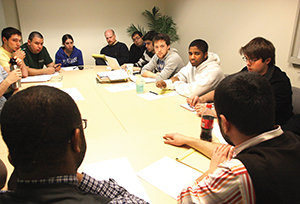
The Off Campus College Transport Board of Directors voted to accept the Student Association’s proposal to remove the Graduate Student Organization from the Board Monday.
With OCCT headed toward bankruptcy, the Board also decided to begin charging graduate students and community members to ride the student-operated blue buses in hopes of bringing in new sources of revenue.
The GSO currently pays 2.5 percent of OCCT’s total operating cost. Student Association President Adam Amit noted that graduate students will be able to ride the blue buses for free for the remainder of the semester.
“We are disappointed by the outcome but it is well within the rights of the OCCT Board. It’s their decision,” said Michael Lipton, vice president of the GSO. “We don’t believe it’s the best decision for OCCT. [But] Majority rules.”
The SA’s plan to remove the GSO came after careful deliberation of the fact that there are three entities — the administration, the SA and the GSO — currently running OCCT.
“Businesses can’t be run with three variable financial inputs and three different political bodies trying to control it,” Amit said in a statement.
Amit presented the SA’s proposal to the board after the GSO proposed its own plan: a transfer of power of OCCT’s CEO and CFO to the GSO, rather than to the current SA leadership, at OCCT’s Board of Directors meeting Feb. 19.
The GSO proposal also asked for an increase in the number of GSO Board representatives from two to three, and a 10-to-3 undergraduate to graduate student driver ratio.
There was also a call to increase the student fee to $16 per graduate and undergraduate student, as well as a $1 charge for late-night service. The number of buses on the road at one time would be cut as well.
The proposals came after OCCT officials announced that increasing the operating costs will dry up the company’s savings and put it in paralyzing debt by 2013.
The OCCT Board of Directors is made up of the SA president and other SA E-Board members, the Off Campus College council facilitator, the GSO president, elected student representatives, a student representative from the Services for Students with Disabilities, the service manager of OCCT, two OCCT personnel and the director of Off Campus College. The service manager, EVP of the SA and the director of OCC are not voting members of the Board of Directors.
BICKERING OVER REPRESENTATION
Conflict began after a lack of communication between the SA and the GSO at the Feb. 19 meeting.
Lipton said that the GSO did not come to the meeting as adversaries but were nonetheless treated negatively.
“We were told we were no longer welcome; our voice is no longer going to be heard,” Lipton said.
GSO executives said that prior to the meeting, they were not provided accurate figures on OCCT’s financial problems, citing numbers presented by Giovanni Torres, OCCT’s service manager.
“We built our entire proposal on limited knowledge,” said Wesley Saavedra, assistant to the GSO president and OCCT Board member. “He made no effort to correct us.”
At the Board of Directors meeting on Friday, Feb. 19, the GSO first introduced their proposal, then Amit made the SA’s proposal to remove GSO from the board. At this proposal, the two GSO representatives on the OCCT Board and Lipton walked out of the meeting.
Offended by what they called the SA’s criticism and the proposed ousting, the GSO held a senate meeting for a strategy session Wednesday, Feb. 24. SA and media representatives who wished to sit in and observe the meeting were asked to leave, which violates New York State’s Open Meetings Law, because the GSO is a public body.
Members said they did not close the meeting out of a malicious intent, but a wish to hold an off-the-record open discussion with their graduate constituency.
GSO President Cagri Idiman sought council from David Hagerbaumer, director of Campus Life, on the legal status of a closed session. Idiman then dismissed the senate and instead held an Executive Board meeting, which can be legally closed to the public.
Although both parties cannot agree on who will run the blue buses, the GSO senate has recently approved fee increases to contribute to OCCT. The GSO currently pays $8.50 per student to the SA’s approximate $14.60 per student.
BEGINNING OF THE BLUE BUS BLUES
Though OCCT has been functioning as a not-for-profit organization at Binghamton University since 1984, looming financial problems started in the 2005-06 school year when it realized a necessary tax-exemption form had never been filed.
Without this form it was impossible for BU to legally contract with OCCT, said Elaine Liu, then-OCCT service manager.
Former SA President Matt Landau released a statement in September 2008, saying that it would take an extra $600,000 for the SA to keep OCCT afloat. If these legal problems were not resolved and the University was unable to pay its share of the OCCT budget, it was said that the SA would not be able to continue full OCCT services after Oct. 10 of that year.
Check www.bupipedream.com for updates