





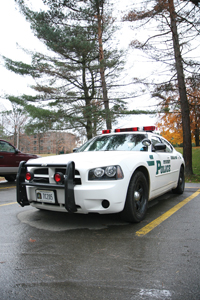
If a gunman or other suspicious person was reported on campus, Binghamton’s New York State University Police Department would have specific plans in place — but officials will not release the details of the plans for the protection of officers and students.
“We don’t know who is reading,” University police Lt. Madeline Bay said.
Should such an incident occur, Bay advised students go the opposite way and find a safe place where students could remain hidden, possibly behind a closed door. Then, she said, it’s important to call the authorities, so other students can be alerted to the danger and protected.
Lt. Rich Becraft agreed, and said that students can make a difference in the sequence of events.
“My suggestion to anyone with a cell phone is to call 911,” Becraft said. “Students should get the wheels of help in motion.”
However, Becraft said, students being directly confronted with weaponry should cooperate with the criminal.
“They should be very subtle in what they do,” he said.
Then, Becraft added, students should call authorities when they have the opportunity, or have a friend do so.
University police officials advised students to contribute information about any possible threats to student safety.
According to Bay, students should keep their eyes and ears open, and report any suspicious conversations that they overhear.
“If students hear people talking about plans that involve guns or weaponry of any sort, listen to that information and take it seriously,” Bay said. “If you hear the little voice in your head giving a warning, listen to it.”
Assistant Dean of Binghamton University’s Graduate School Lindsey Tremain echoed Bay’s sentiments. She suggested students send anyone who they felt voiced a threat to the counseling center or to the police.
A lot of people get angry at different things, but that doesn’t mean they will react violently, she said.
“However, if they voice an explicit threat, students should respond accordingly,” Tremain added.
According to Tremain it is impossible to predict how students will respond to an event on campus involving armed criminals or other dangerous threats, but students should still take such cases seriously.
“We can’t go by the assumption that this is a safe campus; we should be ready to respond to an emergency,” Tremain said.
Although alcoholic abuse, theft and harassment are some of the more prominent security issues University police receives reports of on campus, authorities said students need to know what to do in situations that may be less common.
Students should be aware of exit ways on campus, Becraft said, so they can be prepared in case a dangerous incident does occur.
According to New York state law, exit ways should not be blocked or locked, and students should know where they can get out in case of an emergency, Becraft said.
“There should be a safe and speedy exit,” he said.
University police also takes precautions to limit dangerous incidents on campus. The doors on campus are locked during the night to avoid possible threats to security.
However, Bay said it would be impractical to lock all of the doors during the day.
University police looks to create a safe and pleasant experience at BU, and officials are here to protect everyone at the University, Becraft said.
Tremain has a button on her phone to summon the authorities in case of emergency.
“I have never had to use it,” Tremain said.