




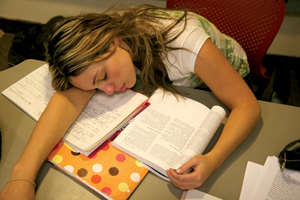
If you are going to classes in a zombie state from preparing for a big midterm the next day, apparently you are not alone. Many students on our campus suffer from sleep deprivation, according to health experts.
“Some of my students were in a semi-comatose state, and these students are usually quite lively and engaged,” said Alan Temes, a lecturer in the physical education department who prefers to be called Talks to Trees. “At least 50 percent of my students appear sleep deprived on any given day.”
According to Talks to Trees, 50 to 70 million Americans suffer from sleep disorders.
The brain is dependent on REM sleep or “downtime for the brain” in order to process and store long-term memory, said Anita Vogely, an adjunct in the health and physical education department.
“Without the needed REM sleep, the brain does not have the optimum capacity to process long-term memory,” Vogely said. ”If you haven’t given the brain time to process information, it won’t.”
Cramming, Vogely said, only works to aid short-term memory. “If you cram today for a test tomorrow and the test is postponed, you would have to cram again in order to be prepared,” she said. “This is because the longer a student waits since they crammed for a test, the less they know.”
Avi Sadeh, a psychologist at Tel Aviv University, studied the effects of adding and subtracting one hour of sleep on 77 children in the fourth and sixth grade, The New York Times reported in October 2007. “Those deprived of an hour’s sleep performed less well on tests for reaction time, recall and responsiveness than the children who slept the extra hour.”
Obesity is also linked to sleep deprivation according to the American Diabetes Association. “Too little sleep causes hormone changes that may lead to weight gain,” according to its Web site. “In addition to diet and exercise, getting enough sleep may be a key part of the weight-loss program.”
An increase in traffic accidents are another consequence of sleep deprivation. According to Talks to Trees, 20 percent of traffic accidents are due to drivers with sleep deprivation. According to the American Diabetes Association, a lack of sleep leads to decreased mental and motor skills.
Students need to change their priorities, Talks to Trees said. “They should make sleep one of the important things they need to do every day,” he said.
Sleep deprivation on campus, Talks to Trees said, may be due to poor time-management skills, spending too much time with electronic entertainment or other distractions.
“Students then realize they have a paper or test, and stay up way too late,” Talks to Trees said. “It appears to be a cumulative effect, and you can’t go without sleep all week and then truly expect to catch up on the weekend.”
In some cases, Talks to Trees said, students are taking on more responsibility than they can handle. “They may overload on the credits they take or work a lot of hours while studying full time,” he said.
Students seem to appear sleep deprived at the library, said Rohan Chopra, a sophomore electrical engineering major and PODS consultant at the library. “A lot of them are sleep deprived because they have an exam the next day and are pulling all-nighters,” she said.