





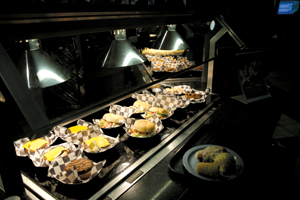
Today, Sodexo offers students thousands of zero trans-fat food products that can be used for healthier meals, said Alexa Schmidt, a dietitian for Sodexo Campus Services.
In September 2005, Sodexo decided to convert to zero trans-fat oils and shortenings. The conversion was completed in January 2006, the deadline set by the Food and Drug Administration for mandatory placement of trans-fat content on all nutritional labels of consumer products.
Sodexo is the food provider for Dining Services at Binghamton University.
“Sodexo was one of the first companies to take a proactive approach and has made excellent progress in its conversion to ZTF since then,” Schmidt said.
Trans-fats are unsaturated fatty acids created during the hydrogenation process in vegetable oils. They also occur naturally in small quantities in animal fats.
“Trans-fats start off as good oil and then the manufacturers add hydrogen, turning it into something that looks and feels like a saturated fat,” said Alan Temes, a lecturer in the Physical Education department who prefers to be called Talks to Trees.
“The FDA has linked trans-fat intake with an increased risk in coronary disease,” Schmidt said. “The vast majority of the products Sodexo buys have zero trans fat as defined by the FDA.”
Schmidt said trans-fats have been shown to increase LDL (bad) cholesterol and decrease HDL (good) cholesterol.
Talks to Trees agreed. “The higher the bad cholesterol, the greater the risk of heart disease,” he said. “Trans-fats increase the risk of heart disease by 2.5 to 10 times.”
Thousands of people are dying prematurely from heart disease, where the consumption of trans fat is a contributing factor, Talks to Trees said.
According to the Food and Drug Administration’s Web site, more than 12.5 million Americans have coronary heart disease and each year more than 500,000 people die from CHD.
That makes CHD one of the leading causes of death in the United States.
Some foods in dining halls, Schmidt said, still contain trans fat.
“However, Sodexo is staying away from trans-fats used in the cooking process,” she said.
Schmidt said that in dining halls there is generally a relatively low level of trans-fats in food items.
Some trans-fat occurs naturally in animal products such as beef, lamb and dairy, Schmidt said. According to the Sodexo Nutrition Calculator, such products served in dining halls include the cheeseburger potato bowl, chili mac, meatloaf, Salisbury steak and shepherd’s pie.
The FDA, Schmidt said, is most concerned with sources of trans-fat that do not occur naturally, such as those found in oils and shortenings.
Talks to Trees agreed.
“The major source of trans-fats is most likely oils and shortenings,” he said.
Some oils used in dining halls at BU, Schmidt said, are olive oil, canola oil, garlic oil and ZTF fryer shortening. “Olive and canola oil are considered healthy monounsaturated fats that have been shown to lower LDL (bad) cholesterol and increase HDL (good) cholesterol,” she said.
Sodexo, Schmidt said, is dedicated to improving the quality of daily life for customers and clients.
“We believe this includes offering practical solutions, including healthy food items and helping address the challenge of having a healthy and balanced lifestyle,” she said.
The New York City Board of Health, Schmidt said, voted to adopt the nation’s first major ban on the use of all trans fats in restaurant cooking. The changes started taking place in July 2007.
The best thing to do, Talks to Trees said, is to avoid trans fats altogether.
“The consumer should aim to keep the combination of saturated and trans fats to 6 or 7 percent of their total daily calorie intake,” he said. “The closer you can get to zero, the better.”
Talks to Trees said awareness about trans fats in foods should be spread.
“A lot of it comes down to the labeling of foods so consumers can make an informed decision,” he said. “I think every dining facility should have information available about food ingredients.”
For students seeking additional information about what’s in the food they eat, they can visit budining.com to view the Sodexo Nutrition Calculator.
Putting food ingredient information online, Talks to Trees said, is not enough.
“Most people aren’t going to go online first to seek out information because we are all too busy,” he said. “If there is labeling on food items in supermarkets, why not label prepared meals?”