





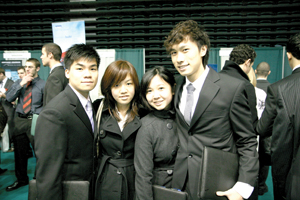
Over 1,300 Binghamton University students wearing shiny shoes and high heels trekked through the rain and slush surrounding the Events Center yesterday with only one goal in mind: to impress recruiters and land an interview.
This was 700 to 800 short of the number of students that attended last spring’s fair, according to Eileen Bauer-Hagerbaumer, the assistant director of employer relations at the Career Development Center. Only 72 organizations were present, a 25 percent decrease from last year.
“In the past, there was a higher percentage of finance [recruiters],” she said. “This year especially it’s balanced; they’re looking for people from all six schools.”
Bauer-Hagerbaumer noticed students at the fair were nervous.
“I think they’re holding back because they’re afraid,” she said. “They need to get on it, can’t rely on only one or two ways of looking.”
Kate Winchell, an accounting and finance major who graduated in December, said it was frustrating to not have found a job yet.
She’s trying to keep her job options open as well as considering grad school.
“I’m keeping optimistic,” Winchell added. “But it’s like running into a brick wall.”
Others agreed.
Mayya Morozovsky, a freshman management major, said she heard seniors in the lines discussing not having job offers yet.
“The fair is important, it’s the last opportunity for some to see so many employers in one place,” she said.
Compared to the fall, Morozovsky said, there were a lot fewer employers and students.
“The mood is calmer; I thought it’d be more rigorous,” she said.
Iris Lau, a sophomore economics and geography major, collected a number of business cards and said she thought the fair was going well.
“Though my legs hurt because I’m in heels and it’s kind of hot in here,” she added.
Students at the fair were acting too relaxed, especially given the current economy, Lau said. They were, for example, asking what kind of internships the company offered at the booths, instead of knowing the information beforehand.
For Hande Erol, a senior management major, the economy wasn’t the only thing to worry about.
An international student from Turkey, Erol said she needed to get Optional Practical Training (OPT), an extension of her student visa, before becoming eligible for employment.
“I am nervous, but they need people to solve the problems,” she said. “It must be approached as an opportunity.”
Not everyone was nervous, however.
“The economy goes in waves,” said Patrick Freise, a junior financial economics major.
“Somebody’s got to take me,” he added.
Employers said they thought the fair was going well.
Samuel Matthews, a recruiter for the Navy, said he has seen somewhat of a jump in people interested.
“It has to do with the popularity of the program, and the economy’s definitely going to increase its opportunities,” he said.
Matthews said he advised students to look at all the options when considering employment and to research all components.
The next step for students after the fair, according to Bauer-Hagerbaumer, is to follow up with everyone they spoke to.
Go on eRecruiting, network, get online, take advantage of opportunities and be aggressive, she added.