





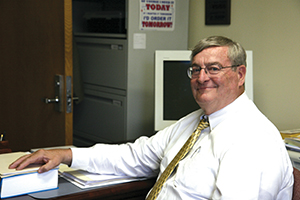
In conjunction with the Cell Preservation Services of Owego, N.Y., and medical schools in Pittsburgh, Duke and Columbia, researchers at Binghamton University have developed a more effective way of treating prostate cancer.
The alternative treatment, known as “cryosurgery,” is considered safer and less invasive compared to past treatments. It is now practiced at more than 160 institutions nationwide.
“It is an out-patient procedure [that] has a surgery that lasts 30 to 45 minutes … most of the men who have it are back to work in a couple of days,” said John G. Baust, director of BU’s Institute of Bio-Medical Technology and a professor of biological sciences.
In a study conducted at Allegheny General Hospital in Pittsburgh, Pa., cryosurgery touted a 77 percent efficacy rate.
“Most of the present minimal invasive therapies are cell-cycle dependent,” Baust said, since the current chemotherapeutic and radiation treatments attack only specific phases of the cell cycle. “Cryosurgery attacks all stages with impunity.”
The hallmark of cryosurgery was the discovery in 1998 of thermal apoptosis by colleague Dr. William Hollister.
With the discovery of thermal-induced apoptosis, Baust and his colleagues created a treatment using long needles with frozen tips in healing prostate cancer.
“The needle is a closed loop stainless steel needle that circulates liquid nitrogen,” Baust said. “And for a certain portion of that rod the rest is insulated … the freezing will progress outwards. Multiple needles are used to do this, the freezing stuff and the tissue will ultimately become completely necrotic and be reabsorbed.”
Cryosurgery, like many cancer treatments, is not without its complications.
“It doesn’t solve all the problems even though one hopes to,” Baust said. “The complications with prostate therapy are related to its position in the body. With cryo, as it’s supplied now, issues with the urethra and the rectum are simply non-resistant.”
The most popular concern of prostate cancer treatment is the possibility of erectile dysfunction.
“The problem with damaging the nerve bundles is that they are embedded in the capsule in the prostate,” Baust said. “Right now there is a study in Duke and UCLA, where they are going to attempt to use focal theory … to identify the originating site of the cancer. The risk of that is there may be unobserved cancer to be treated.”
Treatment of prostate cancer was not always a concern for Baust and his colleague Robert G. Van Buskirk, professor of biological sciences at BU.
“Baust came here as someone whose specialty was cryobiology and looking at insects. That was his background, and I was a cell biologist,” Van Buskirk said.
“We began in the early 1990s on the whole issue of cryotherapy, we began here developing some devices that would enable physicians to freeze primarily the prostate at the time,” Baust said. “A number of companies emerged that built the devices. After the initial five years of device focus, then we moved onto the cell molecular focus.”
Over 20 years have passed since the first foray into cryosurgery. Baust and his colleagues are currently testing combination treatments of cryotherapy with chemical agents and hold many aspirations for the future of cryosurgery.
“Our plans are to continue working down a list of cancers,” Baust said. “This kind of therapy has a near term application: breast, lung, bone.”