





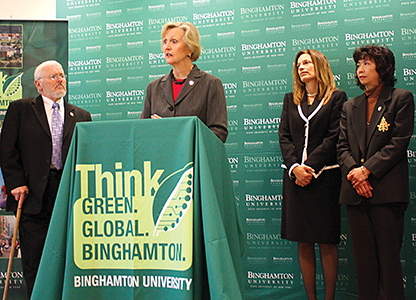
Binghamton University administration is continuing their commitment to a greener future with the release of the Climate Action Plan, a proposal outlining initiatives to reduce greenhouse gas emissions.
The 32-page document, which was unveiled by University President Lois DeFleur during a Monday press conference in Newing College’s Bingham Hall, offers strategies to minimize the use of coal on campus and heat water through solar power, among other goals.
“The total usage of energy on campus since 2000 has gone down 14 percent,” said James Van Voorst, vice president for administration at BU. “And that’s at a time where we had a larger number of students, more programs and more activities on campus.”
According to the plan, coal is the second leading source of campus power, making up 32 percent of the campus’ energy use.
By 2030, the University could reduce 31 to 42 percent of campus greenhouse gas emissions with the use of biomass fuels, such as wood chips, in place of coal. The plan details a strategy to convert all coal-burning boilers in the campus heating plant to burn wood chips. A possible addition of a biomass cogeneration plant would produce electricity and energy from heat created by burning wood chips.
“Obviously we want to change, gradually, the source of our fuel and how we produce it,” DeFleur said. “We also want to lower the amount we use through conservation and saving energy.”
The plan also mentions usage of solar power to preheat hot water on campus, which is currently being tested through solar panels installed on the roof of Susquehanna Community’s Brandywine Hall.
At the press conference, Van Voorst also discussed a wind turbine experiment by recent alumni at the East Gym to power campus vehicles.
However, according to Van Voorst, larger implementation of wind and solar power measures on campus will not come soon.
“Neither of those seem to be right now, with the technology available, viable sources that we can jump into,” he said.
Other areas mentioned in the plan to reduce the school’s carbon footprint include incentives being devised by University Parking Services for those who carpool to campus, a contract with a company for hourly rental cars and the installation of more bicycle racks.
All of these efforts, estimated to be completed between 2015 and 2030, are in coordination with the LEED standards set forth by the U.S. Green Building Council, which rates facilities based on their levels of environmental sustainability.
According to Van Voorst, Newing’s Bingham Hall is planning on a LEED gold rating through use of energy-efficient lighting, heating and ventilation.
The plan was drafted by the Task Force for Campus Climate Commitment, a committee composed of faculty and one student and formed by DeFleur in September 2007 to create solutions for campus environmental issues. It was created after DeFleur endorsed the American College and University Presidents Climate Commitment, which calls upon schools throughout the United States to reduce their carbon emissions.
“Since we’re a large and complex University, this is a very ambitious and challenging [goal], and it’s a very multi-faceted task,” DeFleur said.
Measures outlined in the plan will be financed through research grants, capital investments from SUNY, utility funds, performance-based contracts with companies and savings from energy-efficiency projects.
“Green is not just our school color,” DeFleur said. “This is the right thing to do. It’s not only the right thing to do for our campus, but the right thing to do for our nation and the world.”
The University publishes information on its green efforts at www2.binghamton.edu/campus-climate-task-force/.