





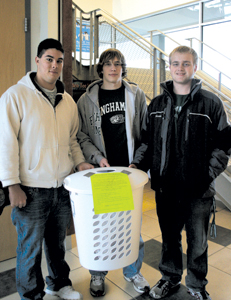
Your old cell phone could save a life — if you donate it, that is.
A cell phone donation drive for victims of domestic abuse is scheduled to be held on campus from now until Dec. 5.
The “Call to Protect” program, established by the SOS Shelter and sponsored on campus by BU’s Scholars Program, provides free cell phones to victims of domestic abuse so they are better able to dial 911 in an emergency. Non-working cell phones and batteries will be recycled, and proceeds from the program benefit the SOS Shelter.
“These cell phones could literally save someone’s life,” Erik Windingland, a freshman majoring in mechanical engineering, said, adding that a collection of at least 100 phones is the group’s goal.
Windingland, a participant in the phone drive, said that victims of domestic violence have a much better chance of survival when they have access to the proper authorities.
The fact that the shelter reached out to the University shows that there are a lot of people who are in need of, and do not have access to, cell phones, he added.
John O’Brien, a scholar and participant in the drive, agreed.
“A lot of domestic violence victims don’t have the financial means for cell phones,” he said.
One in four women, Windingland said, experience domestic violence in their lifetime, and every student on campus probably knows someone who has been a victim of it.
According to Deb Lewis, community relations coordinator for the SOS Shelter, domestic violence is highly underplayed in the United States.
“People just don’t want to talk about it,” she said. “It’s taboo.”
The shelter, located at 83 Front St., provides emergency shelter, community education, awareness seminars and advocacy services on domestic violence throughout Broome County.
Lewis said a variety of women are serviced at the SOS shelter.
“In the past thirty years, the youngest woman serviced was 16, whereas the oldest was in her 90s,” she said.
Nicole D’Avino, a junior and volunteer at the SOS Shelter, said that working with the victims is inspiring.
“While working in the shelter you hear a lot of stories, and even though they are all similar, they are each different,” D’Avino said. “It is nice to know I am helping empower these women to change their lives.”
Lewis said her passion to help others in need came from being a survivor of domestic violence, which came in the form of both physical violence and emotional abuse.
“I knew I wanted a better life for my sons,” she said. “I wanted to get them away from this lifestyle so that they wouldn’t be harmed or repeat patterns of violence.”
Eighty percent of domestic violence victims are women, according to SOS Shelter’s national statistics for date violence in 2007.
However, according to Lewis, there is a misconception that domestic violence is an issue only for women. In Broome County, 5 percent of victims are male. Domestic abuse as a whole is much more prevalent than people think, she said, and can happen at BU.
“Date rape has become a big issue on college campuses,” she said.
Beth Riley, senior counselor and coordinator of the sexual assault programs at the University Counseling Center, agreed.
“We are seeing an increase in the reports of incidents of domestic violence at BU,” she said. “The good news is that people are feeling safe enough to report it, so they can get the help they need.”
Collection bins are located throughout campus, and phones can be donated in any condition. For more information or any questions regarding the drive, e-mail John O’Brien at jobrien3@binghamton.edu.