





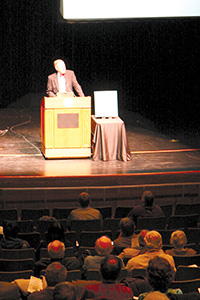
A lecture focusing on a financial crisis 200 years ago and lessons that could be learned from it drew about 100 people to the Anderson Center last week.
The talk, held Friday afternoon, focused on the Panic of 1792. Richard Sylla, a professor of economics at New York University, addressed Alexander Hamilton, the financial crisis of the late 1700s and the lesson the panic could teach people about the current economic crisis.
Sylla had two main themes to his lecture: the differences between rich and poor countries, and why Americans are so concerned with the current economic crisis.
“A lot of the differences the rich countries have is that modern well-functioning financial systems, most of the time … were economic leaders in the past [and] usually had financial development before they became wealthy,” he said.
According to Sylla, one of the reasons why Americans are so worried about the current financial crisis is because most were not alive during the last major crisis.
“[Many are] thinking that something terrible has happened to you that’s never happened before … but it hasn’t happened for a long time.” he said. “Most of us in the room were born after the Great Depression in the 1930s, so that was a real financial disaster and an economic disaster.”
Sylla said Americans haven’t had a “smashed down” financial crisis in 70 or 80 years.
He dedicated the last five minutes of the lecture to the “lessons for our time,” a list of lessons of the 1790s crisis that, Sylla said, could help those dealing with the current financial crisis.
Among the listed lessons, according to Sylla, we have accomplished a few: having a bold leader for the country, trying to keep the country’s banks lending, promoting cooperation among segments in the financial community and learning from past crises.
Following a short question and answer section, audience members were invited to a reception in the Anderson Center where they could snack and talk to each other, as well as to Sylla himself.
Among audience members were economics students, BU professors and Binghamton area residents.
Associate Dean for Academic Affairs Jennifer Jensen said it was “fabulous that we can bring these individuals to speak about these broad topics.”
“I enjoyed being here and hearing the talk,” she added.
Christopher Hanes, a professor of economics at Binghamton University and a noted economic historian, had introduced Sylla to the audience before the lecture.
“The talk was good; I agreed with it,” Hanes said after. “I learned a lot about the early development of the New York financial markets.”
Sylla grew up in Chicago and attended Harvard College. After traveling the world he returned to Harvard and received a doctorate in economics. Since 1990 he has been at New York University.
The lecture was part of the Romano Lecture Series, which sponsors lectures given by noted speakers in history, economics, art history and medicine.
Lucia Cannon, daughter of series creators Mario and Antoinette Romano, believes her father would have very much enjoyed this sort of lecture.
“My father believed that if you were looking to be successful then you had to give back to the community,” she said, “something this lecture has the ability to do.”