





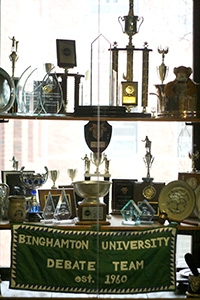
Binghamton University’s debate team has already started the 2009 semester with a bang as it celebrated back-to-back wins at tournaments at King’s College and Clarion University.
Juniors Matt Torsiello and Peter Fountain won the varsity division for both tournaments, beating Cornell University at King’s College from Sept. 18 to Sept. 20 and Wayne State University at Clarion the following weekend.
Junior Rikki Dascal and sophomore Jonathan Silverman also won the novice division at Clarion with a win over James Madison University.
Success of this kind is nothing new for the debate team. Ranked second in the nation last year by the Cross Examination Debate Association (CEDA), Binghamton has been one of the top 10 debate teams in the United States for 10 years. The team regularly ranks higher than teams from other well-known universities, including University of California, Berkley; Northwestern; and Harvard, and has consistently defeated teams from New York University and the University of Vermont in head-to-head competitions.
Unlike most other universities that participate in debate, BU does not consider high school experience to be a prerequisite to joining the debate team. According to director of the debate team Joe Leeson-Schatz, the lack of this requirement “help[s] people gain the benefits of debate if their high school didn’t have a debate team.”
As a result, Torsiello and Fountain became the first team from BU to win a varsity division without any previous experience in policy debating, the style of debate BU practices. Fountain was also named as the top speaker in the varsity division at the Clarion tournament, another first for a team member without high school experience.
One particular hurdle BU’s debate team has managed to overcome is funding. Although the Ted Sommers Endowment for the team was founded with the help of an anonymous donor last year, Binghamton still falls short in its ability to fund trips to tournaments across the country.
According to Leeson-Schatz, the debate team’s travel budget is around $30,000, at least four or five times smaller than that of its collegiate competitors. Liberty University, BU’s rival currently ranked first in the nation, has a $500,000 budget at its disposal.
“We know how to take a dollar, make it stretch and put in the work to show that money isn’t everything,” Leeson-Schatz said.
Binghamton’s debate team members are committed to put in the work to help their team succeed. Every week, each member is required to meet individually with a coach to practice for four hours, meet another teammate for one hour and spend anywhere from six to 10 hours preparing for debates by doing research, finding evidence and practicing other skills on their own. This year’s debate topic focuses on reductions of the U.S. nuclear arsenal.
Varsity team members are expected to travel to tournaments six to seven weekends a semester, while novice members travel four to five times.
“Joining the team can be a little overwhelming,” said Dascal. “It takes a little while to get used to the workload, but once you do, it’s a lot of fun and very rewarding.”
The debate team’s next competition will take place this weekend at the University of Kentucky. They will be making the trip from Binghamton to Kentucky by car — a 12-hour-long commute.