





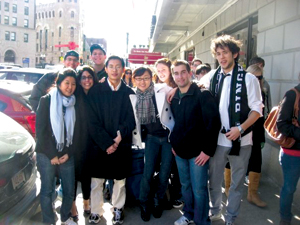
Binghamton University’s Model United Nations club traveled to downtown Boston last week to attend the 55th Harvard National Model United Nations Conference.
The conference is internationally recognized as one of the most prestigious debate forums in the world, according to its Web site, with over 3,000 student delegates representing more than 30 countries attending each year. Over 150 of the world’s top universities participate, including Harvard, Yale, University of Pennsylvania, Boston College, Boston University, Notre Dame and University of Chicago.
This year, BU’s Model U.N. attended for the first time, representing Ghana, and was placed in a tie for third place. They began preparing as early as September with weekly debates.
The debates mimic the format of the United Nations.
The host of the conference assigns different countries to competing schools. Students must research the country’s foreign policy and debate on various topics, such as global sustainability. They are judged on how precisely they represent the views of the country and their ability to pass resolutions for global issues.
John Jensen, president of BU’s Model U.N., received an honorable mention. While rival universities deliberated in partnered delegations, Jensen was forced to compete individually since his teammate was injured in an accident the morning of the conference. Despite the handicap, Jensen received BU’s first National Award at the conference.
For Adam Edwards, a member and freshman political science major, the win is more than a dream come true.
“I’ve been doing this since the sixth grade and the Harvard Conference has always been a dreamy far-off thing,” Edwards said.
Anna Yeo, one of the delegates for the social, cultural and humanitarian committee, said the experience alone was worthwhile.
“This was my first time to participate … so I did not know what to expect,” she said. “Being a delegate in a model U.N. conference was an extremely rewarding and fun experience, and I am definitely doing it again next year.”
According to Jensen, winning is not for the faint of heart.
“In order to win, a delegate must be a powerful speaker, strong legal writer and resolution writer, accurately represent their nations and work to resolve international conflicts in an effective and efficient manner,” he said.
Despite its hard work, the club struggled with funding in the wake of the conference. The cost of competing at two conferences is $8,000 on average, but Student Association funds endowed $1,400 to the club.
“We were mistreated by the SA, and were barely able to go [… we had] to scratch together a plan at the last second when the SA funding fell through, so the fact that we made it and survived is great,” Edwards said.
In the end, each student delegate chipped in $300 to attend the conference.
“Our showing at Harvard was great despite bureaucratic SA procedure that made it increasingly difficult to get to the conference,” said Jeffrey Schwartz, a freshman and member of the club.
Jensen said he hopes the win will allow the club to be taken more seriously.
Model U.N. plans to return to the Harvard National Conference next spring. In addition, they have their sights set on a second competition at the Yale Security Council Conference or the University of Pennsylvania U.N. Conference for next year.