





Corruption of the corporate world fuels the mass production of genetically modified foods, according to a documentary host who lectured at Binghamton University yesterday.
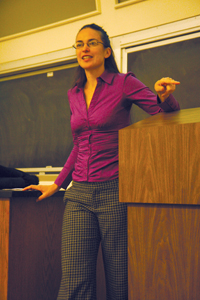
The lecture, given by Caroline Baillie, chair of Engineering Education Research and Development at Queens University in Kingston, Ontario, was held on sustainable development and its impact on society. Hosted by the Binghamton University Scholar’s Program, the lecture outlined several ways in which engineers are affecting the globe piece by piece. Baillie’s discussion focused on identifying what engineers do exactly in terms of sustainable development in the fields of chemical engineering and sociology.
Baillie’s lecture, entitled “Engineering for a Sustainable World,” hit on several socioeconomic successes and how technology can help to achieve growth and development.
“The gap is growing between the rich and poor, and sustainability must work to narrow that gap,” she said.
Baillie is best known as the host of a BBC four-part documentary series titled “Building the Impossible,” and was the former deputy director of the UK Centre for Materials Education at the University of Liverpool. She is considered an expert in explaining engineering in layman’s terms.
Part of the lecture included a video excerpt from the documentary “The Future of Food,” a film about unlabeled genetically engineered food and the truth behind how these products get into grocery stores.
At one point during the presentation Baillie explained how corporations seek profits from the agriculture of under-developed countries, where genetically modified foods are produced and sold en masse.
She said she believed that it is the greed and corruption of the corporate world that fuels mass production of genetically modified foods that can be sold cheaply and in bulk, and therefore these corporations will seek technology that can help their cause.
“Profit has since become the driving force for the development of technology,” Baillie said.
The Scholars Program at BU, headed by Dr. George Catalano, a professor in the Watson School of Engineering, brings in speakers every year to sponsor or co-host various engineering and development events throughout the year.
“The scholars in the program must take a class which links scholars with community agencies in order to give service back to others. The lecture given today by Dr. Caroline Baillie implied that thinking critically and creatively about issues that arise is the way to come up with the best solution, and that is one of the goals to teach to scholars in our program,” Lorelei Wagner, a BU Scholar, said.
Wagner said that Dr. Catalano believes there’s significance in many of the issues that were discussed in today’s lecture, such as the importance of considering social implications in general, as well as through engineering.
Baillie has written over 160 publications, papers and books about material sciences and education.