





A panel composed of human rights activists, academic scholars and former United Nations consultants will come to Binghamton University to discuss the Israeli-Palestinian conflict from alternative perspectives this Thursday.
“We wanted a healthy mix of academics and activists [at the discussion],” Andrew Epstein, a senior history major, said.
Epstein helped organize the event, which is sponsored by the Binghamton Political Initiative. The idea for the discussion, Epstein said, came from a feeling of deep frustration while watching coverage of the recent Gaza conflict over winter break.
“There was a sense that you can’t do much about it,” Epstein said.
According to The Associated Press, approximately 1,300 Palestinians were killed during the three-week Gaza offensive. The Israeli government said 13 Israelis died during the conflict.
Israel began a ground invasion into Gaza on Jan. 3. Officials said their goal was to permanently remove Hamas. The conflict, however, strained relations between the U.N. and Israel after Israeli mortars struck a school run by the U.N. and an Irsaeli air strike hit a U.N. compound.
The fighting drew international criticism, according to The New York Times, due to the high volume of citizen casualties.
Abid Hossain, a junior philosophy, politics and law, and economics double major, said he hoped the audience would gain more of an understanding about the plight of the people in Gaza.
“We really believe there’s a humanitarian crisis there,” Hossain, also treasurer of the Muslim Student Association, said. “We feel it’s something that should be addressed.”
Hossain said he also hoped people who attend the discussion would get a better understanding of the politics of the conflict.
BU professor Susan Pollock, a member of BPI, is moderating the discussion. Pollock said she hoped the discussion would be enlightening for all involved.
The discussion’s goal, she said, is to stimulate a respectful dialogue.
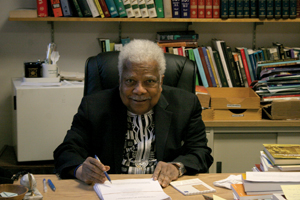
Ali Mazrui, director of the institute of global cultural studies at BU and one of Thursday’s panelists, said he thought the discussion was a good idea.
“I regard the whole war as disastrous,” Mazrui said. “Bad news for Gaza and bad news for Israel.”
According to Mazrui, Israelis have been more critical of Israel’s actions than people outside of the country. He said he hoped more people would question Israel’s actions if they felt they were wrong.
Both Epstein and Mazrui said they felt the American mainstream media rarely show the full picture in regards to the Israeli-Palestinian conflict.
However, Mazrui said, the media’s coverage of the conflict began to change during the latest escalation. Recently, “60 Minutes” had a well balanced edition, he said, discussing what’s at stake in the conflict.
One of the panelists, Omar Baddar, said he intended to speak about the reasons for the most recent Gaza conflict and the events which led up to it. Baddar is the former executive director of the American Arab Anti-Discrimination Committee of Massachusetts and wrote his master’s thesis on the Israeli-Palestinian conflict.
Nada Khader, another panelist, said she was invited to speak in her capacity as both a Palestinian and a Palestine solidarity activist. Khader, executive director of the WESPAC Foundation, was a consultant for the United Nations. Khader plans to speak about her personal reflections as a Palestinian and to discuss her experiences with Zionism.
Epstein said he hoped discussions like this could help create “constructive paths towards ending the cycle of violence.”
“We need to talk about solutions,” he said.
BU Professor Jonathan Karp will also be a panelist at the discussion. Karp is a professor of history and Judaic studies and teaches courses on Jewish responses to Zionism.
All panelists and organizers seemed to agree — their main hope is that audiences will gain a better understanding of the conflict, its roots and the U.S. government’s perspective.
“I would like audience members to leave the discussion having a broader and deeper understanding of the conflict,” Khader said. “And having a more respectful perspective on Palestinians as a people.”
The discussion is scheduled for this Thursday, Feb. 12, at 7 p.m. in Science I, room 149.