





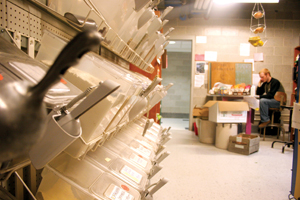
Selling foods from grain rice to a Eurasian drink named Kombucha, or from granola to honeycomb, one non-profit organization has aimed to stay true to Binghamton University’s grassroots claims.
The Food Co-op, currently located in the New University Union, room B-20, was founded in the late 1970s as a buying club for students who wanted to get cheaper and healthier foods. Today, membership to the club is open to everybody and members receive a 3 percent discount off every purchase. And if a member chooses to volunteer at the Co-op, he receives an additional 7 percent discount, adding up to a possible 10 percent discount off any goods.
Non-members can munch, too. About 150 customers walk through the Co-op’s doors on a given day, according to the Co-op’s Vice President Johan Jelsma.
That number would only rise with the re-establishment of the Co-op’s kitchen, which has served vegan and kosher food to a diverse population. But that won’t happen unless the Student Association approves a $16,000 budget for the Co-op.
The Food Co-op attended the SA’s Financial Council, or FinCo, budget meeting on Tuesday in hopes of restarting its kitchen. Roadblocks include antiquated equipment and the hiring of qualified staff. Due to the Food Co-op’s belief in fairness, they pay their kitchen staff $10 an hour.
Moreover, Old Union renovations have forced the Co-op to relocate to the basement of the New Union. Jelsma, a senior, claims that despite Physical Facilities’ promises to trans-locate the Co-op in an adequately large space, they have not done so. That space has gone to Binghamton Television.
When asked why the Co-op did not battle this decision more aggressively, Jelsma said the Co-op was “picking its battles” and had decided to “focus on foundational principles,” that is, to serve to a diverse population on campus without any discrimination to race, gender or educational status.
Thus, the organization is also unsure where the kitchen will operate, since the current location is not big enough for one. Jelsma said they were trying to “wait and see” if new space would open up.
Still, the SA has been supportive of the Food Co-op by more than doubling its budget in the past two years, according to Alice Liou, SA vice president of finance. Jelsma, on the other hand, contends the relationship has been rocky.
For example, the Co-op pays costs by sending a voucher to a client, who then bills the SA. Jelsma claims that the system is imperfect and the SA hasn’t always paid on time. Consequently, the Co-op lost a supplier, Jelsma said.
The Co-op’s official hours are Monday through Friday, 10 a.m. to 5 p.m, but can vary.