





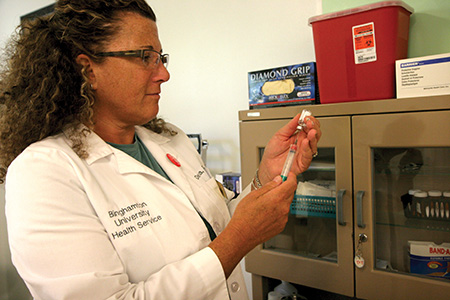
The Center for Disease Control and Prevention is currently in the process of creating an H1N1, or swine flu, vaccination which could be available at Binghamton University as early as October.
Still, delays are to be expected due to government screenings, according to Dr. Michael Leonard, medical director at the University Health Center at BU, which could push back the vaccine’s arrival on campus.
Leonard said the swine flu vaccine will most likely come with some kind of booster or secondary shot.
“Since swine flu is a very particular variety of the flu, it is very new when introduced into the body, and therefore may need a booster shot after the initial vaccine to immunize completely,” he said.
Leonard explained that when the vaccine arrives at BU, it will first be given to high-risk patients, like those with diabetes or asthma and women who are pregnant, but will then be offered to all students as supplies are available.
The University Health Center is still awaiting information from the Broome County Health Department on when it will receive the vaccine and in what quantity.
The vaccine is most helpful to people under 24 years old, who are most susceptible to swine flu, Leonard said.
According to a press release from the U.S. Department of Education, those who do not usually get serious cases of the flu and regular seasonal flu shots are more susceptible.
H1N1 is often problematic because its signs and symptoms are often very similar to other common versions of the flu.
“Common symptoms of swine flu are having both a fever of over 100 degrees combined with a cough or sore throat,” Leonard said.
These symptoms are often commonly defined as influenza-like illness or ILI, which makes distinguishing swine flu from other types of the flu difficult, he added.
The Health Services Department at BU is helping in many ways to make students more aware of the virus and prevention methods, according to Johann Fiore-Conte, the director of Health and Counseling Services.
“It is important that students on campus keep healthy on campus by washing hands, managing anxiety and eating and sleeping well,” Fiore-Conte said.
Both Leonard and Fiore-Conte urge students to call the Health Services office if they feel sick, rather than walking in. Therefore, illnesses can be contained, as well as ensuring that a student is in serious need of medical assistance.
Provost Mary Ann Swain began the semester with an e-mail to faculty and staff regarding the virus as well.
“To be as well-prepared as possible, I asked faculty and other instructors who have teaching assistants to create alternative ways to handle class attendance, laboratories, papers, paper presentations, final examinations and any other course requirements should members of their class become ill,” Swain said.
Swain also encouraged faculty to consider ways in which students can complete their work if they should become ill, either online or through e-mail, so they do not fall behind, and asked them to include all of this information into the semester syllabi for their classes, as well as on Blackboard.