





When walking past room WB06 in the basement of the New University Union, one can’t help but feel a little intimidated.
Home to WHRW Studios: the front room is full of band stickers, paying tribute to artists from The Kinks to The Kooks, an old-school arcade machine and usually a wide assortment of characters lounging on couches, working on computers or simply joking around; but WHRW is so much more than that.
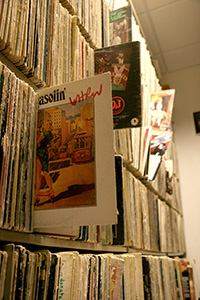
Besides the front room, WHRW is made up of a conference room, two sound studios, a room for on-air interviews and a room which houses all of the station’s music.
One of the few free-format radio stations in the country, WHRW, which was founded in 1966, has the ability to play whatever it wants when it wants to.
“We have the ability to play whatever we want within FCC regulations,” Patrick Maguire, WHRW’s program director and Binghamton University senior, explained. “A lot of other schools can’t do that.”
Funded completely by the Student Association, WHRW plays no corporate advertisements during their shows.
WHRW is completely student-run and is made up of approximately 120 active DJs, allowing the ability to air 24 hours a day, seven days a week.
“You can turn on WHRW at any time and a live show will be on,” Harry Goldberg, a WHRW DJ, said.
Will Grandin, a sophomore music major, joined WHRW in his second semester of freshman year and currently has his own show Thursdays from 2:30 to 4 p.m.
“I’m supposedly listed under the pop section, but really I have the creative license to play whatever,” Grandin said.
During his set yesterday, Grandin played The Beatles, Vampire Weekend and Jimmy Eat World.
Jockeys for the station are not only BU students but members of the surrounding community. Daniel Jan Walikis, a member of Binghamton University’s class of ‘77, has been at the station for 22 years. Affectionately called Dan Jan the Radio Man by other members of WHRW, Walikis has become a staple at the station.
For those who are interested in DJing, WHRW has an apprenticeship program which usually lasts about a semester and consists of shadowing an active DJ, participating in three classes, station service and passing an exam to become certified for being on air.
“The apprenticeship program is the process by which a student or community member who has an interest in WHRW learns what it takes to be a DJ,” Joe Monte, WHRW’s public relations coordinator, explained. “Apprentices have to learn not only the technical stuff but how to be a good DJ.”
WHRW currently has around 60 apprentices for the station.
Besides being able to be on the air for about an hour per week, apprentices and DJs for WHRW are granted the additional perk of access to one of the most impressive not-so-hidden secrets — its extensive music collection.
The third-largest music collection on the East Coast, WHRW houses about 40,000 vinyls and 20,000 CDs, which they have accumulated since the station’s creation in 1966. Genres span from rap to rock, jazz to salsa and everything in between.
“If you played all of our music in a row without stopping, we would be able to be on the air for 10 years,” McGuire said.
Some of their rarest vinyls include artists such as Buddy Holly, Jimi Hendrix and The Beatles.
The station’s signal is emitted from the top of the Library Tower and spreads for a 25-mile radius. WHRW is also broadcasted live via the Web site, whrwfm.org, and on BTV’s station, Channel 42.
While most people simply listen to the radio station from their radio, the station does get some online listeners.
“Usually I have about 11 people listening to my show from the Web site,” Grandin said. “I always know that one of them is going to be my dad, though.”
Currently, WHRW is looking to become more involved on campus and will be co-hosting RAVE Dance Party in the Undergrounds with Late Nite Binghamton.