





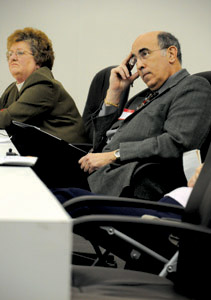
An hour into a public forum held by the Commission on Housing and Home Ownership on Thursday night, around 25 students entered City Council Chamber in single file before seating themselves in the entirety of one row.
They were joined at Binghamton City Hall by local landlords and home owners before the commission, which has been working since January to better city neighborhoods.
An incident on Binghamton’s West Side in February, where students were living in a home illegally according to zoning laws and, according to neighbors, were a disturbance, exacerbated the need to examine city housing, according to Mayor Matt Ryan.
The commission released findings in August that some took as discriminatory toward students and local landlords, prompting the need for a public forum.
“Students shouldn’t be punished for the sole fact that they are students,” said Adam Shamah, who helped organize student participation at the event.
The findings were compiled by Ken Kamlet, a committee member who has drawn criticism for his position with a residential developer that could potentially profit from recommendations the committee will make.
“I came in here with one question in my head, which was, ‘Why are the landlords and why are the students feeling threatened by the potential recommendation from this commission?’” asked David Tanenhaus, executive director of the Binghamton Housing Authority, and a committee member. “I learned that some of the language in an attachment to our report had language that was provocative and that could’ve been misinterpreted.”
“If inappropriately located, [Binghamton University] students can be extremely disruptive to stable neighborhoods,” it said in the 31-page report. “More specifically, many single-family West Side neighborhoods are currently being threatened by high concentrations of students.”
Binghamton’s current zone code includes three designations: R-1, for single-unit dwellings in low-density areas; R-2, one- and two-unit dwellings in a low-to-moderate density area; and R-3, multiple-unit housing in high-density areas.
Residents who have seen their livelihoods hurt by students, in particular two neighbors of students who lived at 8 Lincoln Ave., a home found to be in violation of R-1 law in the spring, explained the troubles they went through. R-1 ordinances stipulate that only people who are considered to be a “factual and functional” family may live in certain areas of the West Side. Six students were living in the home.
Local landlords suggested code enforcement and using laws already in existence as opposed to making broader changes. Landlords also contested that the housing market and those whose livelihoods depend on it would be hurt by limiting the ability to rent to students.
The commission is scheduled to make recommendation in December on whether to change the zoning and potentially limit the number of students to a home.
Tanenhaus, who moderated the public’s maximum five-minute comments, said that the August document, released along with the commission’s mid-term report, was not equivalent to a recommendation. Mayor Matt Ryan, who arrived late and spoke to attendees, and City Council would have to approve the committee’s final recommendations.
The process couldn’t be completed until early summer, according to Councilwoman Teri Rennia, who represents the West Side.
The commentary remained mostly civil until around 8:30 p.m., 15 minutes before the three-hour, 15-minute forum closed. Landlord Scott Abramo, one of many local landlords who spoke, asked the committee if the discussion were about where people of certain ethnicities were living, would the idea even be entertained. His microphone was temporarily turned off and, when Abramo was uncooperative, security was nearly called upon.
Tanenhaus had directed the public not to involve ethnicity early in the proceedings.
Renia said she’s not “anti-student,” but seeks to protect the integrity of the one-family homes in her neighborhood and would like to hear students’ opinions, something she had a hard time doing in the spring.
Ryan said Kamlet, who works for the same company that built University Plaza — Newman Development Group, LLC — does not sit on the commission with a conflict of interest.
“I totally dismiss that,” the mayor said. “Ken [Kamlet] got involved because he’s got some strong feelings about the whole thing, he’s a West Side resident.”
Ryan, Tanenhaus and Alycia Harris, commission chairwoman, all said they took something away from night and that interest in the public’s voice was not just a token display.
“That’s why we’re here, to open it up,” Harris said. “I’m frustrated, because we’re not here to get rid of students.”
Ryan and committee members said the public would be involved again before any final decisions are made.