





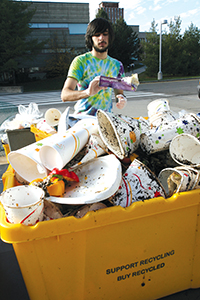
A group of Binghamton University students were seen rummaging through piles of garbage yesterday outside the Old University Union — not for lost items, or food, but for an environmental experiment.
The students were doing an analysis of the waste generated in BU’s four dining halls and the Food Court in celebration of America Recycles Day.
Dr. Juliet M. Berling, environmental resource manager for Physical Facilities, organized the events. Her team of student employees and interns collected waste that people had put into the general garbage containers from the dining halls and food court.
She said that out of the 560 pounds of material analyzed, 40 pounds were sorted out to be recycled and 300 pounds were sorted for composting. The remaining 220 pounds of the material could be neither recycled nor composted, and was disposed of as trash.
“Sixty-one percent of the material disposed from the dining halls and Food Court could have been (and ultimately was) recycled or composted,” Berling said.
She also said that the things they found in the trash were clear indicators of where it came from.
“We could tell which garbage came from the dining halls and which garbage came from the Food Court,” she said. The bags of waste from the Food Court had higher proportions of compostable and recyclable material, but they also contained many non-recyclable materials, such as Styrofoam containers, which are not recyclable in this area.
This is the seventh year Binghamton Physical Facilities has honored the day on campus with events and informational displays. It is part of an ongoing effort to foster better recycling and composting practices and to educate students, staff and faculty on the campus’ recycling procedures.
Berling, in charge of waste minimization for the University, said BU has seen “a reduction in overall waste” since 2003, when she first started holding events for America Recycles Day.
From 2007 to 2008, the University saw a decrease in waste of approximately 310 tons, Berling said. She also said dining halls generate 3,000 to 5,000 pounds of compost daily.
Rich Herb, chef manager of Dickinson Dining hall, works with Berling and her team to manage compost for the University. After the compost is weighed on truck scales on campus, Herb brings it to his local farm.
Before the compost is usable, it must be decomposed. Herb lays the compost in piles and churns it with a backhoe, allowing it to receive oxygen and begin the decomposition process.
Some of the compost is currently used in the Demonstration Garden on Bunn Hill Road. Berling said she anticipates that this year they will, for the first time, generate enough compost to provide to buildings and grounds for use on campus.
Zach Goodrich, a junior environmental chemistry major who works for Berling and Physical Facilities, said he noticed that the garbage weight has been going down and that compost and recycling totals have been on the rise.
“Students are doing a better job,” he said, and that they are “a lot more aware of the program.”
Goodrich acknowledged that though recycling habits are becoming more widely practiced, there is still much room to improve. He said that nearly all waste cardboard gets recycled, but that plastic recycling was more complicated and that not as high of a percentage of waste plastic is recycled.
“It’s just something we got to keep working on,” he said.