





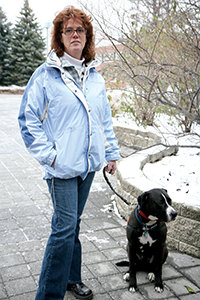
A head injury incurred during service in the United States Navy left Bonnie Pierce with a seizure disorder and brain damage, but has not stopped her from pursuing independent research at Binghamton University.
During her final semester at BU, she is working on research that could identify and follow obesity patterns through computer technology, and she has been admitted to Duke University, where she will begin her graduate studies next fall.
Pierce graduated from Endicott High School and joined the Navy in 1980. She did two North Atlantic and Caribbean tours and one in the South Pacific as a mess hall specialist. While on duty, Pierce suffered a head injury that lead to a neuro-degenerative illness.
After she left the Navy in 1990, Pierce soon decided to go back to school after becoming tired of her unsavory lifestyle and working conditions.
“I wanted more,” she said.
Despite the many obstacles that go along with Pierce’s illness, she is determined to complete her biology degree this month.
Pierce became interested in biological science after working as an X-ray technician. She began her studies at BU in 2006.
Her independent research focuses on the prediction of obesity based on food scarcity in the U.S.
Childhood obesity has become a major medical concern in the U.S. in recent years, and the American Academy of Child and Adolescent Psychiatry estimates that up to 30 percent of children and adolescents are obese. In her project, Pierce takes advantage of computer science to bolster her biological research.
“There is a huge application for biology in computer science,” Pierce said.
By collaborating with Thomas Raway, a graduate biomedical engineer, Pierce is developing a computer program that can predict if certain children are prone to obesity by imputing different weight on data. Pierce utilized online statistics for her research.
“It’s an artificial intelligence program which finds patterns,” Raway said. “She’s trying to set up the prototype.”
Next fall, Pierce will begin graduate work in public health at Duke University. She will focus on epidemiology, the study of what affects health in a given population.
The progressive nature of Pierce’s illness has made her college career challenging. At times Pierce has considered withdrawing from the University, but she cites the support from her family as having given her the strength to stick her with her studies.
“She’s very motivated,” Raway said.
Due to her difficulty with written language, Pierce works with Jesse Elwell, a junior majoring in computer science. Elwell volunteers twice a week to work with Pierce on applying the context of a computer language to the correct syntax.
According to Elwell, his work with Pierce has taught him a great deal about how broad the term “disability” is and how endless the possibilities of research are.
“If you work hard, people will extend themselves to you,” Pierce said.
Chocolate, a playful seizure-response dog, accompanies Pierce to her courses. He knows his way around the entire campus.
Pierce has two sons and a 1-year-old granddaughter.