





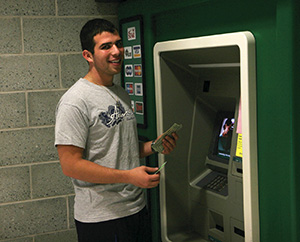
Starting in February 2010, the newly-passed federal Credit CARD Act of 2009 will restrict students under 21 from obtaining a credit card in their name. In order to get a card, students will have to apply with a credit-worthy co-signer or prove that they are financially capable of paying their bills.
College students often mishandle their bank accounts and go into credit card debt. To combat this, the Credit CARD Act of 2009 will leave a whole bracket of students who are ineligible for credit.
This act could likely hinder students from actions such as taking out loans for graduate school or financing a car. The Act will not affect current credit card holders, but it will put limitations on banks trying to sign students up for credit cards on campuses.
“[The Credit CARD Act] is a good idea because most kids of college age are not responsible,” Morenike Jegede, a senior bio-chemistry major, said. “Of course the credit companies want the student [customers]. I like to shop; it’s tempting.”
According to a study of undergraduate college students compiled by Sallie Mae, 40 percent of card carriers charged items knowing they did not have the incoming money to pay for it.
“You have to live within your means,” said Barry Jones, an associate professor of economics at Binghamton University. “I don’t know if making a law will help you. It’s about responsibility.”
Payment card providers, such as nFinanSe, are taking the opportunity to offer alternatives to applying for a credit card while providing some saving tips. NFinanSe offers reloadable prepaid cards which can act as a debit or credit card.
To establish credit history while in school, Clare Morgan, vice president of marketing for nFinanSe, recommends opening up smaller lines of credit, such as a card from a department store.
“For college students it’s the old story of instant gratification for things that are consumable at that moment,” Morgan said. “In conjunction with school fees and school loans, it can be disastrous.”
Additional steps can be taken to help prevent credit debt while in school.
“Students should have a budget financial plan,” Jones said. “You can never miss [loan] payments. Check your credit rating on Equifax.”
It is important for students to be careful with their finances. With all the distractions that come with college life, as well as living in a Web-based world where one needs plastic in order to shop, it can be difficult to keep track of your spending.
“It takes one mistake or overdraft and your fees can rack up drastically,” Morgan said. “The reloadable card is a tremendous budgeting tool. The money on the card is all you have to spend. Using it becomes a walking bank account.”