





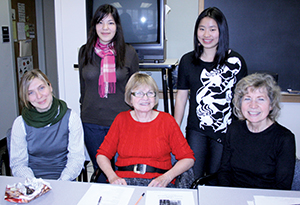
Binghamton University’s German Club and the German and Russian studies department will commemorate the 20th anniversary of the fall of the Berlin Wall with a 6-foot long cake and other festivities.
On Monday, in the Grand Corridor of the Fine Arts Building, the cake, donated by Sodexo, will be on display starting at 1:15 p.m. East German and Russian poetry and music will be presented at the event.
“The fall of the Berlin Wall signified the end of the Cold War, an end to the separation of families and the release of political prisoners,” said Ingeborg Majer-O’Sickey, associate professor of German at BU, who grew up in West Germany. She remembers how East Germany was seen as an island in the middle of Europe.
O’Sickey came up with the cake-wall idea upon seeing a brick wall memorial during a past visit to Cornell University.
“I had wall envy,” O’Sickey said.
Harpur Dean Donald Nieman will cut the cake in a ceremony at 1:15 p.m. After 1:30 p.m., students are encouraged to stop by and grab a piece of the Berlin Wall. The cake will appear to be falling in jest.
Students will also be able to use colored icing to mock graffiti the “western” side of the wall, mimicking the political messages of anger and hope that covered the cement surface.
“The cake will be approximately 5 feet long by 22 inches high,” said Katrina Miner, marketing manager for Sodexo. “Sodexo often donates cakes to campus functions. The cake will be transported by hand cart and delivery van.”
The Berlin Wall was erected in 1961 by the USSR to physically separate West Germany from the German Democratic Republic [GDR], given to the Soviets after World War II. It quickly became a symbol of the Iron Curtain and isolation from the West, pitting the might of Communist Eastern Europe against the Western world.
In 28 years of the walls existence, 171 people were killed trying to cross into East Germany. On Nov. 9, 1989, the Wall was opened up and Germany was reunited 11 months later.
Wenyan Gu, freshman vice president of the German Club, sees the event as an important marker that paved the way for change globally, especially in her native China. Gu added that the fall of the wall opened up study abroad opportunities for Chinese citizens.
“[On Nov 9], rights were given and oppression in [Europe] was lessened,” said Chantal Berendsen, freshman German Club member who will be running the event. “If we don’t learn from history, then we will repeat it.”
Berendsen, who was born in Germany, has seen parts of the Berlin Wall in museums across her native country.
The fate of the wall was much publicized in the U.S. when President Reagan said in his 1987 Berlin Address, “Mr. Gorbachev, tear down this wall.”
By 1987, the GDR and USSR were on the verge of economic collapse. According to O’Sickey, the Soviets were moving toward losing control in their satellite states, and it was only a matter of time before the wall was opened.
Long before Reagan’s speech, civilians of East Germany and protestant activists of the Nikolai Church risked their lives to stand against the oppression of the GDR regime and to bring down the despised cement wall.
The fall of the Berlin Wall was a triumph for democracy and oppressed German people.
O’Sickey will be showing films throughout the week in memory of East Germany. On Nov. 9 at 9 p.m. she will screen “Der Himmel √É.√ºber Berlin,” also called “Wings of Desire.” “Goodbye Lenin” will be shown on Nov. 19 at 9 p.m. Both films will be shown in the Science Library, room 306.