





The residence halls are usually filled with shrieks of students, the booming bass of a nearby dorm and the hum of people studying silently in the lounges.
Imagine these same hallways with the occasional bark of a dog, a person searching for a lost hamster or your roommate showing off her new pet parakeet.
Although this is the vision that some students may want to see, most pets are not allowed in the residence halls of Binghamton University.
Students are allowed to have small fish in resident halls as long as the residents living together agree on this arrangement. The prohibition excludes all other animals, including reptiles and birds, according to the 2008-09 University Housing License. Animals are also currently prohibited from all buildings on campus, with the exception of certified guide dogs and other service animals for individuals with disabilities, according to the 2008-09 Rules of Student Conduct.
Paul Stroud, associate director of Judicial Affairs, said that he believes pets aren’t allowed in the residence halls because the University is concerned about safety and the environment of a college.
“The University does not want pets becoming loose on campus or doing damage to other people, in example biting students,” said Stroud, who has two dogs at home. “I recommend that students follow the rules if they are thinking of bringing pets on campus.”
Christopher Herron, a resident assistant in Mountainview College, also promotes following the rules while living on campus.
“I’d suggest that people planning on bringing pets to the residence halls think about the mess they could make, and whether people whom live with them or could live there next year could be allergic to them,” Herron said.
Herron has only had one resident in three years time try to keep a pet — a rabbit — in the dorms, and he said the problem was resolved quickly.
“They simply brought it home the next weekend,” Herron said.
Eric Chernow, a sophomore industrial and systems engineering major, said he believes the rules for residence halls were put in place for a reason.
“I think the noise problem is a big factor, and who is going to watch all these pets while the kids are in class?” Chernow said.
But for students living off campus, the possibility of having a pet is more feasible.
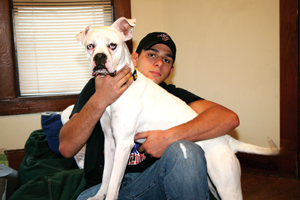
BU senior Will Childress, who lives on Chapin Street, adopted a dog with his three housemates a little over a week ago from the Front Street Dog Shelter. The students decided to name the dog, a white boxer who was found as a stray, Ringo, because he has a blue ring around his pupils.
“They [the staff at the shelter] like to know about the living situation, the rooms in the house, will the dog have enough room to be comfortable and will the dog be monitored at certain points throughout the day,” Childress said. “It worked for us because we’re all students so he [the dog] is never alone for more than an hour or two out of the day.”
Along with the application process, Childress said that the shelter also requests contact with a student’s landlord when considering an application for adoption.
Cassie Maroney, who works the front desk at the Humane Society at 2 Jackson St. in Binghamton, also said that her organization works closely with landlords when determining if a student can provide the right fit for an animal.
“We do ask for references, and we do like to talk to parents,” Maroney said, adding that the Society does see a number of students looking to adopt.
An adoption committee is responsible for finding the best home for the pet, whether that means living with a student or in another situation. Maroney also said that a lot of the time students who have adopted end up bringing the animals back at the end of the year.
“That’s really not fair to a sheltered cat or a shelter dog,” she said.
Childress and his housemates took this into account when they decided to adopt Ringo.
“We’re not giving him back,” he said. “Whoever has the best situation will keep him after school.”