





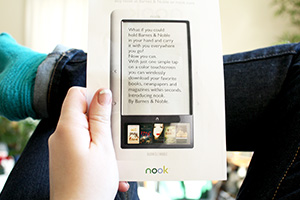
As the spectrum of electronic educational materials expands, many Binghamton University students will choose whether to go digital with their studies.
With the first week of the semester marked by long lines at Mando’s and the University Bookstore, a number of students are noticing the benefits of shifting to electronic materials.
“E-books are part of a technology-driven change,” said Bruce Hildebrand, executive director for higher education for the Association of American Publishers. “They’re cutting-edge. You can do [in text] searches. You can take notes. They have flexibility, portability.”
The bookstore began selling e-books through Universal Digital Textbooks, an electronic textbook site along with MBS Textbook exchange, two years ago, and students can buy the e-books online or in the store and obtain an access code.
“You are buying something that can be accessed by our patrons anywhere, anytime,” said Caryl Ward, head of acquisitions for Binghamton University Libraries who handles e-books. “The materials don’t get lost or destroyed. Users can highlight or bookmark.”
Ward noted that obtaining a physical book from a distant location can take a long time, whereas e-books arrive within days to the University.
Electronic texts can be downloaded to PCs or e-readers. E-readers are handheld devices, such as the Amazon Kindle, that use e-ink technology: chemicals printed to a plastic film to resemble a page of a paper book. E-ink’s sophistication was developed so as not to cause the eye strain associated with computer screens.
Alexis Sigman, a junior majoring in English, has utilized e-books and online resources for her courses.
“I prefer them more,” she said. “They are cheap and convenient. You don’t have a ton of books to carry around.”
Hildebrand said he saw the e-book market emerge a decade ago with the boom of the World Wide Web. Widespread high-speed Internet access has made the possibility of large quantities of information, such as entire books, available instantly, he said.
They’re also a third of the cost, and more environmentally-friendly, according to Heather Prescott, BU bookstore manager.
Still, Prescott noted they are unpopular, estimating that the bookstore has only sold 12 e-books since the start of the school year.
“They take too long to load, are hard to navigate and the part you want is sometimes missing,” said Ryan Krenzer, a senior majoring in biology.
Although Krenzer has used e-books for sources and study guides, he does not recommend e-books for study purposes, unless the primary objective is to save some money on the book.
“The majority of students still prefer printed textbooks,” Hildebrand said. “There is a comfort level with them.”
According to Hildebrand, electronic educational materials will replace printed versions as digital materials for the K-12 generation evolve.
“It will be a great thing for students,” Ward said about making e-books widespread to BU students. “But it will take a couple of years to pan out.”