





Binghamton University’s men’s basketball team isn’t the only one on campus caught up in March Madness.
Pixelated sparks will fly later this month in “BattleCode,” a computer game where two programmable armies of robots wage war. This year is the first time BU has ever competed in the competition.
The Massachusetts Institute of Technology is hosting a national tournament among colleges, where the top eight teams of coders compete for up to $40,000 in prizes at MIT in early April.
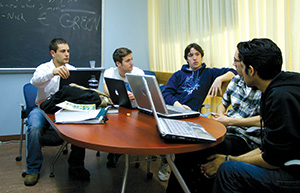
Four BU students, David Lundgren, Gregory Stoddard, Tony Worm and Jason Loew, are teaming up for the competition as the “Beercats.”
Each robotic army in “BattleCode” contains six units, ranging from workers to cannons, whose movements and actions are programmed using Java. The artificial intelligence of the robots is determined through set lists of commands called application programming interfaces. Teams rearrange these lists to create behaviors for the units.
“If you’re playing a video game where the X button is for jumping and the Y button is for kicking, and you want to figure out how to jump kick, you press X and Y,” Stoddard, a junior computer science and math major, said. “It’s similar to that.”
Players win the game by eliminating the other army or mining the most flux — a resource that strengthens the power of units.
“We noticed in testing that most of the games were won through mining the most flux,” Lundgren, a junior computer science major, said.
The team drew inspiration from the movie “Independence Day” to formulate a strategy that would do this.
“If you’ve seen the movie, similar to the aliens, we sit in one location and use up all the resources, then move in a giant mass to the next location,” Lundgren said.
According to Stoddard, the only drawback of the plan is that other armies can sometimes mine flux faster by splitting into smaller groups.
Stoddard is working on two additional strategies. One would divide the army in half, while the other would rush the enemy at the start of the game.
“The war rush idea is to prevent them from mining all the flux by destroying them quickly,” he said.
Teams can test their ideas by scrimmaging with others over the Internet in friendly battles or by downloading other teams’ armies to play against them offline.
BattleCode is taught as a class at MIT, and students who can devise strategies to beat a reference player, which is a generic artificial intelligence made by the developers of the game, receive an A in the class.
“We’re hoping to beat the reference player first,” Lundgren said, in preparation for the tournament.
The submission deadline for each team’s plan is March 29.
Stoddard plans to spend more time honing the team’s strategy as the deadline approaches, combining the previous ideas into one final plan.
“It’s going to be at least four hours a day,” he said.
Lundgren said he became interested in the program over winter break.
BU Professor Leslie Lander is allowing excelling students in her CS 140 Programming With Objects classes to form teams and strategies for the BattleCode tournament as an alternative to their current homework assignments.