





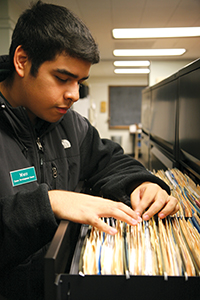
The Career Development Center announced last month that it will cease operation of their Credentials File service by July of next year and will usher current users of the service to an online system.
According to the director of the CDC, Nancy Paul, the switch to Interfolio, an online credentials file management system, was a way to “change and grow in response to changes in the world.” The current service, which uses a physical filing system to manage over 20,000 files, has existed almost unaltered for over 30 years.
The switch to Interfolio represented the CDC’s most recent phase of modernization of credentials file management, and was intended to keep up with expectations for convenience and speed that accompany the modern technology of computers and e-mail.
“More and more [students asked] if we could send things electronically,” said Terri Kilcy, the credentials coordinator for the CDC.
She said that professors are often frustrated that they have to mail letters of recommendation to the CDC. She also said students and alumni would frequently ask to view and send their files to graduate schools or employers from their computer.
According to Kilcy, the current system is not able to satisfy these requests.
This summer, they met with the University’s Information Technology department to develop an online solution, but realized Interfolio would be the better option.
“It’s really much better than we could ever do,” Paul said. “For us to develop something here at the University would have taken much longer.”
She also said the cost for an internal upgrade, which would require purchasing new scanning equipment and providing technical support, would be similar to the cost of Interfolio.
The CDC does not currently charge users of its credentials file service to maintain the file. It will, however, cost users $19 to set up a one-year account with Interfolio. Basic deliveries of credentials will also cost $5 — a dollar less than they do under the current CDC system.
Interfolio offers many additional features that the CDC currently does not offer.
Through Interfolio, students and alumni can store any number of various document types in their virtual file, including cover letters and writing samples, which the CDC files would not accommodate.
With Interfolio, all documents are stored on a secure server for any amount of time, while current CDC policy dictates that all files not accessed for more than a 10-year period be destroyed, Paul said.
People with an Interfolio account can also use it to tag documents with certain reference labels, create a specific selection of documents to send to several institutions and view a table of contents of their file, as well as the full text of any non-confidential document.
“It’s almost as if you’re ordering something on Amazon,” Paul said. “They’ve really thought of everything. Why should we grow something at home when we have this?”
In their September announcement of the switch to Interfolio, the CDC indicated that current service will stay until July 1, 2010. The CDC presented current users of the system with three options.
The first is to create an Interfolio account and to submit a request to the CDC to have all materials in the CDC credentials file transferred to Interfolio, a service they will provide for free.
Users of the current system can also request that their file be transferred to the career services office at another college or university, which the CDC will also do free of charge, as the second option.
The final option is to let the CDC close the file and destroy all materials.
Although the CDC is unable to release confidential letters of recommendation directly to students or alumni, they can request that the letters be returned to their original writers, who can then decide where to send the letter.
“But I can’t make that choice for the letter writer,” Kilcy said, indicating that doing so would break the agreement of confidentiality.
According to Kilcy, students are permitted to receive a student copy of any non-confidential documents.