





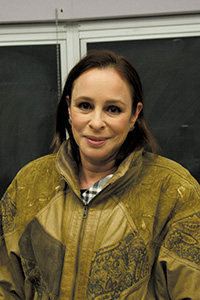
Alina Fernandez Revuelta said she still remembers the day when Mickey Mouse disappeared from Cuba forever. Revuelta, a daughter of former Cuban dictator Fidel Castro, spoke to a packed lecture hall Wednesday about her childhood in the communist nation.
Revuelta, Castro’s illegitimate daughter, lived in Cuba for 40 years before fleeing to the United States to provide for her child and tell her story.
Taniya Thomas, a junior chemistry major and the insight chair of the Student Association, booked Revuelta’s appearance.
“This was a good idea to show something different, something we never had [at Binghamton University] before,” Thomas said.
When Revuelta was a child, Mickey Mouse was replaced by slogans like “Viva Cuba Libre” and swarms of revolutionaries parading down the streets on TV. “Freedom for Cuba” quickly became “to the wall.” She didn’t understand she had witnessed televised executions of Castro’s political opposition until years later, Revuelta said.
“I come from a country where the revolution is endless,” she said.
Revuelta described her father as a charismatic orator who loves to talk; his first speech as a leader lasted eight hours.
“You never had dialogue with Fidel Castro,” she said. “You just listened.”
Religion was banished under Castro’s regime. Free press and intellectuals soon followed. Castro’s party controlled all media and telephone lines, leaving Cubans unable to call other countries. Since 1960, Cubans were issued rationing booklets for food, creating a widespread black market for unattainable goods.
Castro opened up the jails and mental hospital, allowing the undesirables to go to the United States. In what became known as the Peter Pan Operation, 14,000 children were issued visas, the largest recorded child exodus. Revuelta’s stepfather, a doctor, and sister left with the others. The state dubbed all Cuban emigrants as traitors.
The disappearance of Mickey Mouse, food and half of her family led Revuelta to feel discontent with Cuba’s regime, she said. She recounted how the government turned its citizens into spies or vigilante secret police.
These “defense committees,” she said, were in every neighborhood, watching and reporting. Family members turned against each other because of divergent political views. According to Revuelta, the spies and government propaganda instilled fear throughout Cuba.
Revuelta’s dissident views stemmed from the lack of political and economic reforms Castro’s revolution brought. She said that in her eyes, the dictator never stopped manipulating international attention.
“I feel Fidel used Cuba for his political ambition,” she said.
A student in the audience asked Revuelta if she was opposed to her father’s ideology, the “socialist dream.”
“I am a fan of the dream,” Revuelta said. “But that [dream] did not happen.”
Revuelta said that, as she grew up, she became ashamed of her connection to Cuba’s regime; she could see Castro’s family was eating well while the rest of the population was not. In 1989, Revuelta joined the public dissidence movement in Cuba.
Fearing that her daughter would not receive an education in Cuba, Revuelta said she began to seek a way out.
In December 1993, Revuelta escaped from Cuba disguised as a Spanish tourist with a false passport. She later came to Miami, where she resides today.
When asked what she misses most about her homeland, Revuelta replied, “the dancing.”
Revuelta said she hopes that the new president, Raul Castro, will put into practice successful strategies to stimulate the Cuban economy.
At the close of the lecture, a long line formed in front of Revuelta at the podium. The eager students wanted to exchange a few words with the woman who stood against her father’s revolution.