





If there’s one thing constant in life, it’s change. You can only plan for so much until nature takes its course and throws you a curveball. But if you embrace that life is all about figuring out where you belong and use each experience as a stepping stone to lead you to where you’re meant to be, the unexpected becomes exciting.
Many influential figures knew it was their calling to be an artist from a young age, but for some, the path was less straightforward than for others. Here are four influential artists who found their calling in nontraditional ways.
Virgil Abloh
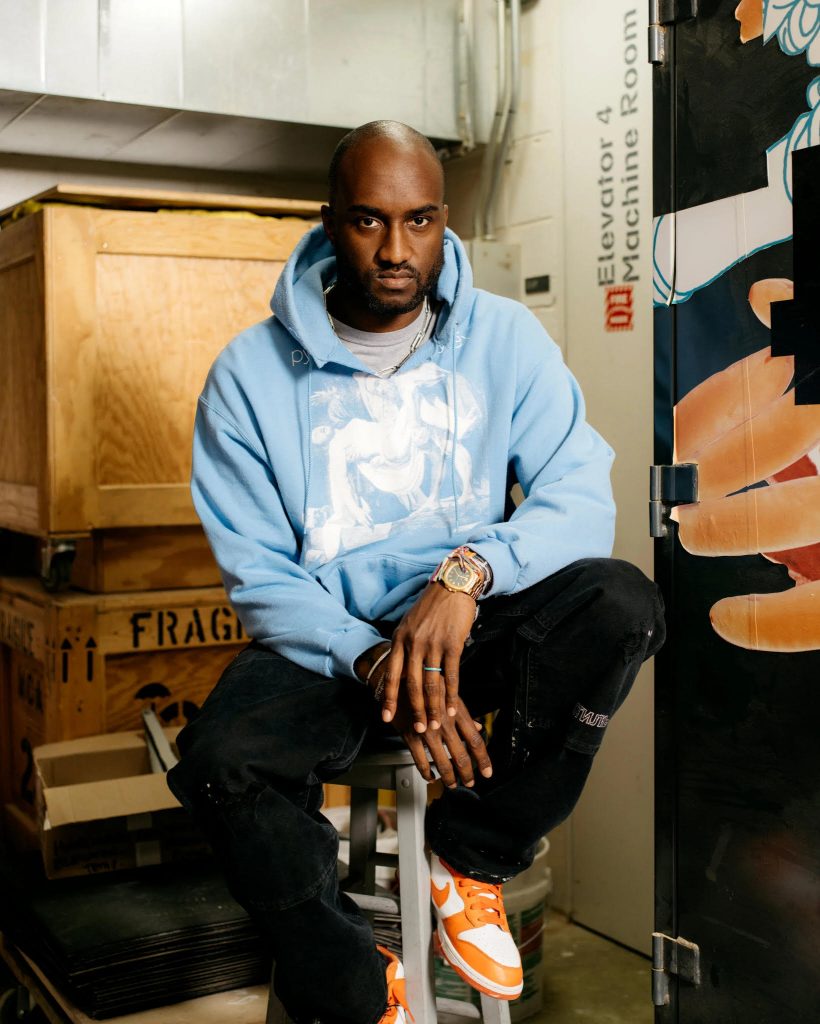
Artistic director of Louis Vuitton men’s and founder of Off-White, Virgil Abloh transformed what streetwear looked like in the luxury market. However, his genius didn’t start like typical designers. Abloh grew up in Chicago, earned his bachelor’s degree in civil engineering from the University of Wisconsin-Madison in 2002, and later studied architecture at the Illinois Institute of Technology. Outside of school, Abloh worked on multiple projects as a DJ, designing T-shirts and writing for the blog The Brilliance.
In 2007, Abloh was introduced to Ye, who was just beginning to gain attention as a music producer, and was hired to be part of West’s creative team. Drawing inspiration from history, architecture and music, Abloh’s unique creative approach allowed him to launch his own clothing line, Off-White, in 2013. His lasting impact of blending the lines among luxury, street culture, music and art defined his storytelling style and continues to influence present-day designers and creatives.
Tadao Ando
One of the most influential architectural movements of the modern era was shaped by Tadao Ando, a self-taught Japanese architect who won the 1995 Pritzker Prize while never taking a single architecture class. Born and raised in Japan by his great-grandmother, he grew up watching craftsmen work and realized school had nothing to teach him. By the age of 17, Ando was a professional boxer, traveling across Asia. During a trip to Bangkok, Ando visited Buddhist temples that sparked his interest in the way spaces were designed. He went on to travel across Europe, studying the buildings he had read about in books, and returned to Osaka in 1969 to start his own firm.
His philosophy and Buddhist influences are seen throughout each of his projects, using light as a controlling factor to create a zone for oneself within society. His use of few elements and emptiness gives his work a deeper meaning, keeping his work silent and allowing nature to be present within the space. Ando went on to design museums, cultural institutions and private residences. He also taught at Yale, Columbia and Harvard and his influence can be seen in geometric skylights, concrete walls and intentional silences that have been built into contemporary architecture worldwide.
Young Huh
Young Huh, a widely praised interior designer, grew up in Detroit prior to settling down in New York. While previously pursuing law at Fordham University, Huh found herself conversing with an interior designer at a party and quickly realized her true calling. Abandoning her evolving legal career, Huh enrolled in Parsons School of Design to study interior design classes and interned at multiple design firms to develop her craft. In 2007, Huh opened her own firm in New York, specializing in luxury residential and hospitality interiors, using influence from the disciplined approaches she learned in law school.
It’s not just this overlap that Huh embraces, but the meshing of her cultures as a Korean American. Huh was recognized among top talent on Architectural Digest’s AD100 2023 and 2024 lists, named one of Vogue’s five interior designers on the rise and can be seen in the pages of The New York Times, Elle Decor and The Wall Street Journal.
Henri Rousseau
While this unconventional concept is more progressive, it’s not to say it didn’t exist decades prior. Henri Rousseau, born in 1844, ended his studies in secondary school and entered military service for four years. Later settling in Paris in 1868, Rousseau became a tax collector in the Paris toll office while finding time outside of work to draw and paint, something he had done since his childhood.
His early career as a painter began when the Salon des Indépendants admitted his work. Despite his art going largely unnoticed for the next seven years, Rousseau had an intense desire to express himself artistically and was later recognized in the avant-garde review, Le Mercure de France, marking the beginning of his recognition as a serious painter.
It’s not uncommon not to know where you want to be in life, and similar to these four artists, their unconventional career paths are what set them apart. The rejection of conventional norms can still produce influential artists if passion exists. If you have a desire to tell your story, don’t let the fear of having a different background stop you from pursuing a creative career. Art is all about bringing something new to the table, so use those differences to make something meaningful, and let your experiences guide you to where you’re meant to be.