





Counting calories? There are other choices for the thirsty student than the mass-market, highly-advertised “light” beers. The biggest thing these beverages are light on is flavor. There are various other options that won’t pack on the calories, yet are still full, flavorful beers. Let’s take a look at some numbers that illustrate the paradoxical world of light beer.
Michelob, part of the Anheuser-Busch family, produces a standard lager with 155 calories and 13.3 grams of carbohydrates per 12-ounce serving. Their “light” beer, however, still contains 134 calories and 11.7 grams of carbs in a common 12-ounce serving. That’s not much lighter, is it? Also, considering nearly all light beers have a lower alcohol content, one must drink more of them to produce the same desired effect, potentially increasing the total number of calories consumed.
There is a similarly underwhelming contrast between Coors Original (does anyone still drink this stuff?) and Coors Light, with 148 and 102 calories, respectively. There is a reduction of calories, but also at the expense of flavor and alcohol content.
Others, such as Budweiser versus Bud Light and Miller versus Miller Lite, actually do exhibit a considerable contrast in the numbers, with Budweiser’s 143 to 95 calories and Miller’s 143 to 96 calories, but at what cost? I propose an alternative approach to beer-drinking: drink less, drink better.
David Antanavige, a Binghamton University graduate student working on his master’s in physics, embraces this to the fullest.
“Life is too short to drink light beer,” he said.
Many modern drinkers choose to enjoy hearty, full-bodied beers, ignoring the caloric value altogether. It sounds dangerous, yet there is a hidden wisdom.
You could drink just a few finely crafted big beers over the course of a night instead of countless light beers. They can be enjoyed slowly, savored over a longer period of time. This means you may actually consume fewer calories over a given period of time. In addition, many big beers like India Pale Ale and Imperial Stout have higher alcohol contents, meaning fewer of them will deliver the same effect as a half-dozen of their “lighter” counterparts.
There may be an additional ethical concern for some of the more conscientious consumer.
“Hearty beers are more likely produced by microbreweries, a burgeoning industry we need to support,” said BU grad student Stephan Piotrowski. “Not light beer … don’t encourage them to keep making crappy beers.”
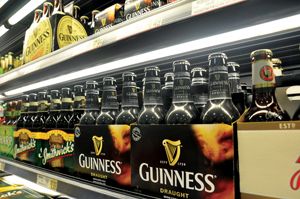
However, there are flavorful beers that don’t necessarily upset one’s diet. Guinness, for example, is not nearly as heavy or potent as people commonly assume. With only 125 calories and 4 percent alcohol by volume, it’s closer to light beer than many fans of the dark stuff would like to admit. Yuengling is another option for those counting calories: 135 per 12 ounces.