





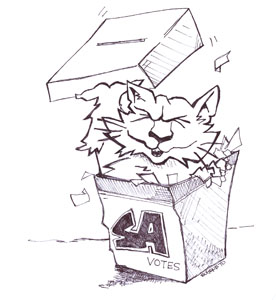
APPROVE, SA Constitutional Changes
The changes narrow the focus of different executive board positions for the better (See Page 4). The Assembly easily passed the changes, and we think they could only help things in the future. Obviously, what’s more important than what the constitution says about executive board positions is the caliber of people in them …
RICKY DA COSTA, Vice President for Multicultural Affairs
Position description: The vice president for multicultural affairs works with the vast plethora of cultural groups at BU as well as with the Intercultural Awareness Committee to organize programs and events to promote a better understanding between the many cultures on campus.
Multicultural from the womb, as he put it, Da Costa seems like a natural fit. His involvement in myriad cultural organizations — Black Student Union, Caribbean Student Association, JUMP Nation to name a few — puts him at the frontlines. Despite the VPMA’s shaky fate as a position in the SA, Da Costa plans to take it seriously. Yadin Herzel said culture is not just a hobby. Both candidates would take the job seriously, and we think Da Costa would use his “face-to-face” networking best. His plans for a zero tolerance policy and a reformation of the ICA, along with his cultural ties, will allow him to “hit the ground running” as he said, and mobilize initiatives.
AARON COHN, Vice President for Programming
Position description: The vice president for programming oversees all activities and programming sponsored by the SA.
Aaron Cohn is best prepared to enter into negotiations with big-name acts next year. He’s learned from the former and current vice presidents for programming, Sandi Dube and Aaron Butler, respectively. And when it comes to discussing potential deals with artists that can run as much as hundreds of thousands of dollars, experience should be a valuable asset. The VPP has more to do than just the big act. There are the smaller acts as well, which Nico Meyer rightly points out, and is a point we hope Cohn understands. But let’s be honest — we care most about whether we’re getting Kanye … or just some guy who tours with Kanye.
Cohn also has a concrete idea of how to fix the SA Programming Board’s perhaps one glaring shortcoming — a clearly defined method for garnering student input on acts. We like Cohn’s proposal of a research chair, and hope he follows through and maximizes that position’s potential with surveys and other forms of outreach to the students.
DAVID LUNDGREN, Vice President for Academic Affairs
Position description: The vice president for academic affairs is responsible for representing the student body on all academic issues and concerns.
Lundgren’s ideas were truly refreshing: He proposes that instead of outsourcing projects, the University contracts with in-house students and programs and use the talent we already have to better ourselves. For example, art students could help design new benches around campus. He also proposes expanding the ways students can receive credit so that hands-on learning experiences, usually more effective than classroom settings anyway, will count on your transcript more frequently than it does now.
Lundgren’s a relative newcomer to the SA, so we do warn of one thing: don’t get carried away. An infusion of new ideas will be healthy, particularly when it comes to the mundane of academia, but there will be some standard issues that he’ll need to handle. We hope he doesn’t lose sight of those.
EDMUND MAYS, Vice President for Finance
Position description: The vice president for finance oversees all income and expenditures made by the SA and all of its student groups.
It’s not an easy call over Matt Allwood, but Mays seems to be the prototypical FVP: organized, knowledgeable and understanding of the dedication the position needs. Mays is always in the SA office and offers a tool that could prove invaluable to student group executive boards: an analysis of spending at the end of every year. The changing of the guard amongst student groups causes annual mayhem among the groups. Knowledge of how previous e-boards spent could prevent problems from recurring and set a proper path for the future.
Rod Alzmann had one idea we really, really want to see implemented: the digitizing of the SA’s voucher system, which Alzmann said could mean the SA would issue payments with a turnaround less than two weeks. Nothing could make student groups appreciate the SA’s efforts more than quicker payment times.
JARED KIRSCHENBAUM, Executive Vice President
Position description: The executive vice president oversees the activities of each of the Student Association chartered groups — almost every club on campus as well as all community governments.
Kirschenbaum’s served in a position of the same title with Hillel and JSU, two successful student groups with good programming history, which is really the best prerequisite to the position — a firm understanding of student groups’ needs, in and out. More than that, though, you have to be personable and something of a diplomat, especially when trying to get groups that might not normally collaborate on the same page, and Kirschenbaum has that affability. He also outlined specific situations — and, more than that, specific situations that seemed viable — in which collaboration could take place when it does not.
The Student Group Council, however, and how Kirschenbaum leaves it could determine his legacy. As it stands, the SGC is ineffectual and poorly attended, but there should be a place for dialogue amongst the leaders of student groups. Kirschenbaum’s first task should be to identify that place.
JOSH BERK, SA President
Position description: The president acts as the chief ambassador between the students and the administration while serving as the official representative of the student body.
This year’s slate of presidential candidates is impressive: students from walks of life besides the stuffy SA office are represented — BSU and greek life for instance — and it bodes well for the future of student politics on this campus.
For the problems the SA has had this year, chief among them the sense that it has accomplished little, we don’t need a total regime change — that would prove more of a hindrance right now — just a little vision. Josh Berk is an SA insider who thinks differently than his peers.
Berk spoke to Pipe Dream’s editors about the importance of looking outside the box, something those around him rarely do. And with his experience as Assembly chair this year, Berk can step into the role of president without missing a beat. He already has had dealings with the mayor, he has connections with administrators and a broad vision: He’s looking to the long-term future of the SA with ideas such as capital investment.
Adam Amit’s resume, at face value, is the most impressive, but he comes off insincere and too political — we don’t know if he’s running for us or running for his resume. (If you check his Web site, you’ll learn what student government positions he held in middle school.)
Aaron Butler focused on his ability to unify an e-board, and that’s what we hope Berk can do. The in-squabbling must end, it’s petty. Berk has a mighty task on his hand.