





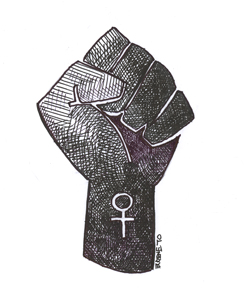
After claims that Hillary Clinton had put 18 million cracks in the glass ceiling, a local program designed to encourage leadership in girls from grades seven through 12 strives to emulate Clinton’s example of furthering women’s rights (see Page 1). Without doubting that they have equality’s best interests at heart, we wonder whether this program’s designers — and people in a similar position — went about things the right way.
We commend their efforts to encourage school-age girls, but we also balk at the sight of a “Project Runway” opportunity, which gives girls a chance to design slogans for T-shirts. This may be a minor league example, but is “Project Runway” really the example we want to promote for women’s leadership? The two female designers who work with the students may be leaders, but at the same time they work in a world that is nothing groundbreaking for women. Coco Chanel and Donatella Versace were leaders for women when that concept was even less plausible, but don’t we have other female leaders to look to for guidance these days? While the program states that women from local leadership positions will be speaking, can it be assumed that they are representative of the diversity of fields that claim to be open to women nowadays?
Perhaps the keynote speaker should best understand this unfair stereotyping — she was selected to attend Oprah’s O-White House leadership project and no doubt has stories about her trials and tribulations as a councilwoman for the city of Binghamton. Just the same, she was recognized in a program created by Oprah, a cultural icon, but a female talk show host nonetheless.
We’re not faulting this conference alone; a quick look at Oxygen, TLC or other so-called “programming for women” suggests that this is a problem on a much grander scale. While there might be something to the saying that stereotypes contain a grain of truth, there seems to be a distinct dismissal of women with interests that range beyond societal norms, even in the 21st century.
Are the majority of women to reach broader fame the ones who stick to traditionally female careers? Is this really the message we’re interested in sending to our future female leaders? We fully support the “Girls Take Charge” initiative, but just the same, perhaps a more serious title would be more fitting.
Binghamton University’s women’s basketball team at the start of the month held a promotion entitled “Girls’ Night Out,” which was aptly criticized in a letter to the editor of Pipe Dream in our Feb. 13 issue.
Leadership conferences shouldn’t sound like the title of an adult movie, nor should they refer to future leaders in a diminutive fashion. First impressions can be the most lasting.