





Deadly snakes, rare birds, ancient forests and composting toilets are just some of the things that were enjoyed by more than a dozen Binghamton University students who spent their summer trekking through jungles in Central America.
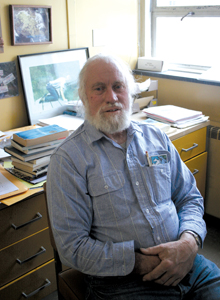
Richard Andrus, an environmental studies professor at Binghamton, has run a yearly, month-long summer course on tropical ecology in Costa Rica since the 1990s. Last July, 18 BU students participated in the program, which gives students both course and internship credit. During the program students stay at a Tropical Forest Initiative base on the western side of Costa Rica near San Isidro de El General.
“TFI’s goal is to promote a model of reforestation with mixtures of native species,” Andrus said. “It began in 1993 as an alternative to monocultural replanting.”
Since 1996 BU students have interned with TFI by planting trees, managing wildlife habitats and conducting wildlife surveys, as well as conducting experiments on the grounds while taking the tropical ecology course.
Ben Eisenkop, a senior biological studies and ecology major, and Nathan Rose, a junior music and ecology major, both participated in the program last year.
“I don’t think there was a time where I wasn’t pouring sweat; it was literally 95 degrees in the shade in the rain forest,” Eisenkop said. “We were macheteing through old banana plantations and vine tangles on a nearly 90-degree slope of slick mud which was infested with snakes.”
“We ran into one snake several times, the terciopelo, which is easily the deadliest in the country,” he added.
Eisenkop said he had been planting trees when someone called out in Spanish that he found one. He cut down a banana tree to look, and when he lifted the tree leaves away there was another terciopelo curled up under them.
“I hacked it to pieces out of gut reaction,” Eisenkop said. “I’ve probably never been so terrified in my life, but when the nearest hospital is four hours away by dirt road, I don’t take chances.”
According to Andrus a typical day during the program starts around 6 a.m. when birds begin to wake people up.
“Usually we do strenuous hiking and work in the morning when its cooler,” Andrus said.
By 10 a.m., everyone goes swimming. The afternoon is devoted to academic work, Andrus said, and evenings are free. He said everyone goes to bed by 9 p.m.
The students also traveled around the country to ecotourism attractions, national parks and the cloud forest reserve at Monteverde.
“The land was absolutely beautiful,” Rose said. “We saw everything from monkeys, sloths, armadillos and crocs to poison dart frogs, snakes, scorpions and tarantulas, leaf-cutter ants, basilisks and a boa.”
“Plants were all unique and possessed the entire color spectrum — oranges, reds and even purple plants,” he added.
According to Eisenkop, in addition to constant sightings of rare birds, the students saw a type of glass frog that hadn’t been seen in over five years in the Monteverde mountaintop.
“The food was especially good — lots of fruits like mango, starfruit, pejibaye and bananas, and rice and beans with every meal,” he said. “Also we were able to catch and cook our own fish and even slaughter a pig, a communal event that supplied us for a few weeks.”
Other activities students participated in included mingling with local people at town parties and Guanacaste Day, where they learned traditional dances from local school kids.
“San Isidro is not like any U.S. city,” Andrus said. “There are 5,000 little stores and they’re all different. My favorite is a Xeroxing and ice cream store. In Costa Rica every combination is possible.”
The living conditions were more rustic than the typical American living.
“At our ‘main base,’ we slept in cabins under mosquito nets, showered in river water (pumped into shower heads), pooped in composting toilets, washed our clothes in buckets and traveled around with mud boots and machetes,” Rose said.
Andrus said that during the trip he thought people talked more than they would otherwise, and that humor became more important.
“Without wires social interactions are interpersonal,” Andrus said. “People play cards a lot because there is nothing else to do.”
The program costs about $3,200 for in-state students.
“You have to be in good health and come up with the money,” Andrus said. “Lots of different people qualify and they’re often not bio majors.”
The program grants six credits, four of which are upper-level biology and two of which are internship credits. The course includes typical academic work, such as lectures and discussions. Students are also required to take a midterm and a final and keep an extensive journal, according to Andrus. Each student did a small research project.
Andrus and Eisenkop both highly recommended the program.
“We got to see what most people only see through postcards or on a DVD of ‘Planet Earth.’ It was truly amazing,” Eisenkop said.