




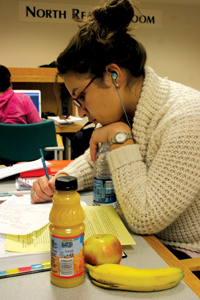
With finals around the corner, students may find themselves battling with time and pressure while trying to prepare for their next test or paper. Luckily, there are some ways students can make the most of their time and survive the last days of the semester, according to experts.
RESEARCH AND STUDY TIPS
Colleen Hailey, bibliographer for business and cinema in Glenn G. Bartle Library, said students should use the library database to search for information for classes rather than using Google.
The library database, Hailey said, contains scholarly peer-reviewed articles, which is what most professors look for.
“Anyone can put anything on Google,” she said.
Louis Alerte, a tutor for the Educational Opportunity Program, said that students should learn the fundamentals of the material they study, as opposed to memorizing flash cards.
“Sometimes students already know the answers are on the back and as a result they don’t challenge themselves enough,” he said.
According to Alerte, it’s better for students to work alone at first and then in a group.
“Students working in groups get a chance to hear other people’s responses and arguments,” he said. “This technique may help them to develop better answers to possible test questions.”
William Wilson, a sophomore majoring in economics, said he thought students should look at the breakdown of their classes to determine how to prioritize their studying.
“Look at how much each assignment and final is worth and then focus on whichever one has the greatest impact on your final grade,” Wilson said. “Why spend more time studying for a final that only counts for 20 percent of the grade when you could be using it to studying for one that counts more?”
GETTING FIT FOR STUDYING
If students aren’t used to staying up late, Alerte said, they shouldn’t try to do it with caffeine.
“I’ve seen people shake when they’ve had too much caffeine or power beverages for the first time,” he said.
Donald Glauber, a staff psychologist at the University Counseling Center, agreed.
“Don’t rely heavily on artificial stimulants,” Glauber said. “They often produce short-term bursts of energy followed by decreases in energy.”
Drinking plenty of water, Glauber said, is important as well, because of the risks associated with dehydration.
According to Glauber, breaks from studying should involve physical movement. Glauber suggested activities such as walking, swimming or any other enjoyable aerobic exercise.
“These activities will help get the blood flowing so once students return to study their performance will be enhanced,” he said.
Aerobic exercise allows more oxygen into the blood and subsequently energizes the brain.
Alan Temes, a lecturer in the physical education academics department who prefers to go by “Talks to Trees,” said it isn’t necessary to do a heavy workout.
“Even walking up and downstairs in your dorm room can reduce stress, which is a related symptom of impaired memory function,” he said, adding that eating small portions of food can also help.
“Eating too much can make you feel sluggish and may limit your ability to absorb information,” he added
Fruits, Glauber said, are good snacks for students to eat while studying.
“They have healthy sugars which provide energy without stressing out the body,” he said.
GETTING IN THE ZONE
Glauber said students should find a personal benefit that they hope to gain while doing their schoolwork.
Having curiosity about a topic will give students a better experience while learning, he said, and a more successful outcome in the studying process.
Talks to Trees said sleep problems are the second-leading health impediment to academic success.
“Sleep is needed to restore the mind,” he said. “It also helps consolidate the learning we do throughout the day.”
Practicing slow diaphragmatic breathing, by counting from one to 10, he said, will help relieve stress and anxiety before an exam.