





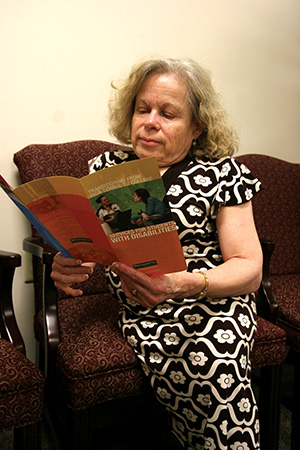
As the Services for Students with Disabilities staff settles into a new office — which they have waited for since the early ’90s — Binghamton University has begun to spread a new message, according to SSD’s director.
Earlier this month SSD vacated its complex in the basement of the Lecture Hall, which was supposed to be a temporary spot following a move from the Engineering Building in 1991.
Since moving into Lecture Hall B51 the BU officials and SSD staff discussed possible alternative locations, such as the New University Union, but Director Barbara Jean Fairbairn felt it was too difficult to get to from the rest of campus. The renovation of the Old University Union proved to be the perfect opportunity.
“It was an ideal time for the need and the resources to come together,” she said. “The architects and the designers really listened to us so carefully. They were sensitive and responsive to our needs.”
Fairbairn said that when she and now Assistant Director Carol Hall initially moved to the basement of the Lecture Hall, the facility, while “not easily accessible and not visible,” did meet the department’s needs. But as SSD grew, the spot became too tight.
The new location, in Room 119 of the Old University Union, is a better fit for SSD and the more than 300 students it works with, whose disabilities range from learning and physical disabilities to autism spectrum disorders and chronic health conditions.
“The space is just marvelous for us,” Fairbairn said.
Within the new location there are four personal offices, a space for the secretary, a reception area and a technology room where students can work with staff. In addition, the complex boasts an automatic door and a lounge intended as a quiet space for students who need to take a moment for themselves.
The previous complex included two and a half offices, where passersby had to walk through one to get to the next; a smaller reception area and a room down the hall that housed half of the technology the staff currently uses.
“A student who uses a wheelchair said how nice it is to be able to come into [the] office and turn around without bumping into something,” Fairbairn said. “So that said it all basically.”
Aside from the fact that the complex is more spacious, its location in the hallway leading from the Kosher Kitchen to the Mandela Room will help the office in terms of disability awareness and education.
“It’s very normalizing,” Fiarbairn said, adding that the building as whole, with water fountains and information desks that are lower to the ground than in the past, is affirming.
“Although those of us with disabilities adjust and get used to the world in general, it’s much more welcoming and respecting,” she said.
Selena Adler, a junior majoring in anthropology, has worked with the office since last year. She’s heading a project aimed at establishing a peer advocate position for students with disabilities under either the Student Association vice president for multicultural affair’s office, or within the Student Assembly.
Adler’s efforts are focused on getting campus to be more disability-friendly. She said that the previous location of the office sent the wrong message to students.
“I think it [the new location] is very positive,” she said. “I think it forces students to confront something that they might not be completely comfortable with.”
Fairbairn echoed Adler’s sentiments.
“It’s a question of what’s appropriate in terms of not only access, but the message the University is promoting in terms of the value of people with disabilities,” she said.
While she acknowledged that it’s been a “long temporary,” Fairbairn said she chooses to look at the glass as half full.
“It wasn’t as if we were ignored by everybody on campus; there were people sticking up for us. It just took a while,” she said.