





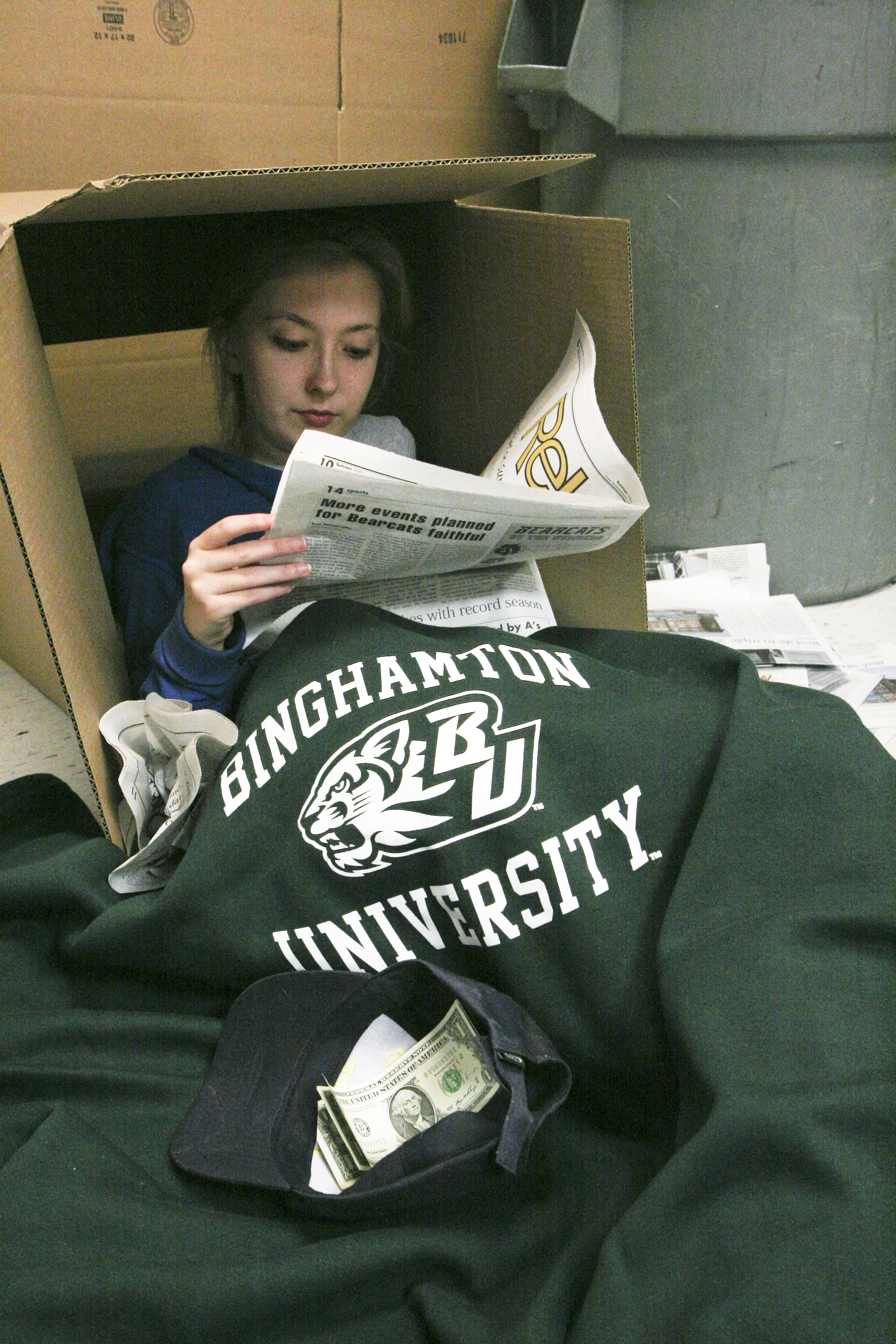
With friends to hang out with, obligations to different clubs and sports, tests to study for and papers to write, thinking about life after college may seem a little overwhelming to start processing.
College is a place that holds a lot of fun and memories. But, ultimately, it is a place that is supposed to prepare you for a career outside of this institution. Yet not everyone knows what direction they may want to go in after school.
Kelly Curran, a junior biochemistry and Spanish major, admitted that deciding what to do after Binghamton can be a little daunting.
“I’m not exactly sure what I want to do. I would like to do something I like because it is something you have to do every day, for the rest of your life,” Curran said.
However, Curran is not alone. It is not uncommon that a student does not know what to do with their undergraduate degree.
Bill McCarthy, associate director of the school’s Career Development Center, explained that students either know what they want to do or they don’t. For some it might take a little longer than others.
But because careers and jobs are not necessarily permanent things, people can change what they want to do often.
“Statistics show that people can have eight to 15 jobs and two to five careers in a lifetime,” McCarthy said. “You can start in one job do it for a while or go to a different career in the same industry.”
Know that there is a difference between a job and a career. A job is where you spend hours of your life to pay bills. A career holds a passion, what you like to do, essentially an extension of who you are.
A first step to working toward a career is discovering and being aware of your interests, skills and values.
There are many ways to do that through the CDC. Students can do a search on the CDC’s Web site on the link “Career Library Resources” to find books pertaining to their major and go to the center and take it out. There are also profiles of both undergrads and alumni on the Web site that highlight what each has done to be where they are.
McCarthy stated that contacting alumni with similar careers may be a good way to decide if it is right for you.
“You are listening to content to gather data to effectively decide ‘Is that what you want to do?’” McCarthy explained. “To see what’s out there can validate what you like.”
But there are other opinions you could consider in the process of deciding what may work for you.
“I consider what interests me, but I’ve also considered the help of professors and friends with similar majors,” Curran said.
A second step on your journey to pick a career for yourself may be to assess and explore what you say you want to do. You can do that through internships coordinated through your major department and the school’s Career Development Center, or work in various departments or centers on campus. You can also contact current alums trough the alumni career network to see what Binghamton alums have done with various majors.
“Student employment and career development internships, you can test drive a career,” McCarthy said.
While getting a job straight out of college can be a little daunting, especially in this economy, future graduates could consider volunteer services such as the Peace Corps or AmeriCorps.
Programs like these have increased in popularity over the past couple of years. Teach for America, an organization placing recent graduates in teaching jobs across the country, experienced a 42 percent increase in applicants from 2008 to 2009.
For some, expanding your education and applying to graduate school could be the best option.
“You start on a journey with a destination that you can, of course, correct,” McCarthy said. “You’d be surprised at what you may discover.”