





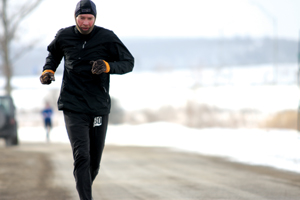
It’s snowing. The temperature has dropped below zero, and the wind chill, at its worst, is a brutal 20-below. While these harsh conditions will make most people inclined to stay bundled up inside, they don’t faze Terry Powell. Zero degrees, negative 20 degrees. Nothing stops Powell from going out for her midday run.
Powell, a junior engineering major and member of the University’s cross country and track and field teams, is dedicated to running. The cold doesn’t make her skip workout or send her to the gym for a monotonous hour on the treadmill. And the Binghamton cold shouldn’t frighten you either; after all, if you go Downtown in these temperatures, you have no excuse not to exercise.
Follow these tips from a couple of your fellow runners and you can keep running outside this winter, even in the lowest temperatures.
WHAT TO WEAR
Powell recommends layers. Her bottommost layer is always spandex or any other breathable material.
“No cotton,” she said. “It traps sweat. Anything wet will freeze really quick.”
She said that you can wear cotton as your outermost layer only. She also suggests wearing a vest. “It traps heat in your core,” she said.
To keep her legs warm, Powell wears spandex running pants. On top, a headband or a baseball cap and hood. On a chilly day, she wears spandex gloves, but when the temperature drops below 20, she finds that mittens keep her hands warmer. Powell recommends EMS Windpro spandex gloves or a pair of Brooks fleece mittens. On her feet, she wears SmartWool socks.
“Expensive,” she said, “But they dry quick.”
PRE-RUN PREPARATION
Professor Gary Truce, who coached the cross country and track and field teams for 26 years, advises runners to warm up properly.
“You need to loosen up the different parts of your body that you are going to use,” he said. “Get your joints ready to move.”
He said that you should spend six to nine minutes warming up, and during these cold winter months, you should warm up inside. Truce jogged in circles around his office to show that you can prepare for your run just about anywhere.
THE RUN
Truce says it takes time for your body to adapt to colder temperatures. “It takes at least three days before your body begins to adjust,” he said. During those three days, your run should not exceed 15 or 20 minutes.
Once your body fully adjusts, the road is yours. If it’s an especially cold, windy day, runnersworld.com recommends breaking up your run. Run for 20 to 30 minutes; head inside to warm up for about five minutes, then head back outside for another 20 to 30 minutes.
IS IT SAFE TO RUN IN THE COLD?
Truce said the cold can be healthy and compared running in the cold to putting food in a refrigerator.
“The cold stops bacteria. Outdoor cold can help kill germs,” he said.
Still, you are bound to catch a cold if you’re not dressed properly.
“Being cold creates a stress on the body,” Truce said, “And stress weakens the immune system.” He said if your hands or feet get cold on your run, you should get indoors right away.
Of course, it’s not always safe to be out running during these winter months. When it’s icy, rainy and slippery, it might be better to stay inside.
“I wouldn’t take the chance of hurting yourself on an icy day,” Truce said. He advises indoor exercises, such as the stationary bike, weights and even running in place.
However, if you are just dying to be outside and the sidewalks and streets are too icy, Truce suggests putting on boots and running in the snow. He recommends the field behind the University track. With a couple feet of snow and a pair of heavy boots, you have the perfect workout.
“One loop around that field is like running 10 miles,” he said.
If Binghamton’s arctic weather is just too cold, it could be time for a break. Truce considers running to be a form of play, “like a kid out playing in the snow,” he said.
“Running should be joyful at all times.”