





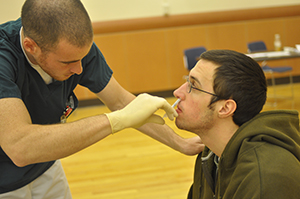
Binghamton University Health Services provided its fourth H1N1 vaccination clinic Thursday in the Mandela Room as part of an ongoing effort to prevent or limit the spread of the virus.
As of Monday night, Health Services has confirmed only one case of the strain of influenza at BU so far.
Gail Mathieson-Devereaux, coordinator of clinical service for Health Services, said it was a slower day for the clinic.
“We’ve done almost 90 so far today,” she said. On other days, she said 700-800 students showed up for vaccinations. “To date we’ve given approximately 1,700 doses of H1N1 vaccine.”
Health Services is running low on doses of the vaccine, but they will receive more as soon as they become available.
“We’ve ordered enough to cover every student,” Mathieson-Devereaux said. ”But whether we’ll get that many is unclear.”
Health institutions across the country were unprepared because the H1N1 strain was discovered after production began on the seasonal flu vaccine, Mathieson-Devereaux said.
According to Mathieson-Devereaux, the H1N1 vaccine is separate from the seasonal flu shot but there is suspicion that next year the seasonal vaccination would include the H1N1 strain.
At the clinic Thursday, Health Services provided the vaccination in the form of a nasal spray only, which has been a disincentive for some students.
The nasal form of the vaccination is administered in a syringe, which many people associate with a needle, Rob Faurote said, a student of the Decker School of Nursing who was administering vaccinations. But there is no needle, and it is sprayed into the nostrils in the manner of common over-the-counter nasal spray medications.
Senior finance and mathematics double major Dahye Ham said she was hesitant at first, as it was her first time taking the nasal spray.
“First I thought it would be worse than a regular shot [but] it was better than a regular shot,” she said.
Sudeep Phatak, an industrial engineering graduate student, said it was his first his experience with the nasal spray as well.
“It was kind of a new experience for me,” he said. But he said it was not as intrusive as he expected. “I didn’t feel much. Just a little air.”
A syringe of the vaccination is sprayed into each nostril, and each syringe contains a dose of .1 milliliters.
“People are nervous about it just because it’s different,” Faurote said. “It’s funny that more people are nervous about it than a shot.”
Mathieson-Devereaux also encouraged all students to get some form of the vaccination. She said that people up to age 24 are “considered the highest risk” population. People older than 24 are more likely to have been exposed to the strain before and to have some immunity.
Mathieson-Devereaux noted that the clinic was a collective effort. She said Decker students helped administer the vaccinations, while Decker clerical staff and representatives of Residential Life helped with registration and Harpur’s Ferry staff was available to provide emergency services if necessary.