





One moment the Binghamton University professor is visiting Kazakhstani colleges. The next, he’s confined to a hotel room awaiting trial “like a canary in a golden cage.”
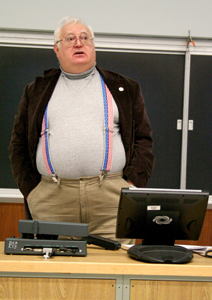
The engineering professor who was detained overseas for over a month last semester and convicted of currency smuggling spoke about his experiences in Lecture Hall 1 last night.
Distinguished Service Professor Victor Skormin, who had been meeting with Kazkh professors at various universities and recruiting students for BU’s graduate school during his trip abroad, was stopped by customs authorities on Sept. 29 on his way out of Kazakhstan. When he tried to leave the country with his payment of $14,221 in American currency, however, Skormin was detained and charged with currency smuggling. He was able to return home on Nov. 3.
“They were clearly implying that I had to pay to get on the plane,” Skormin said. “I didn’t give them a bribe for two reasons: I never gave a bribe to anybody. The second reason was that I thought that if I would offer a bribe, I would be committing a crime.”
Skormin’s captivity was cause for much talk on campus last semester, and his situation in Kazakhstan was complicated by his need for medication for his diabetes and high blood pressure.
“This is a corrupt part of the world,” Skormin said as he explained how expensive medication is often counterfeited in the country. Taking such medicine gave Skormin kidney failure.
The hospital Skormin went to, which was known as the “President’s Hospital,” required money to be paid up front. When Skormin finally did receive care, it was hardly what one might expect.
“We can’t help you tonight, nobody is in,” Skormin recounted being told. “But you probably won’t die until morning.”
One of his doctors told him a joke about the hospital’s name.
“They call it the president’s clinic,” the physician had said. “I don’t know why, the president owns everything.”
With the help of a letter from BU, Skormin was able to avoid prison. Instead, he was confined to a hotel room while he awaited trial like “a canary in a golden cage.”
Skormin had a lot of time to think while he waited, he said.
“You have this internal dialogue with this merciless internal prosecutor,” Skormin recounted to the audience. “Victor, why the hell didn’t you wire the money?”
Skormin also thanked those who helped him through his confinement, especially Jim Moronski, an adjunct lecturer at BU.
“He felt my pain, I had an opportunity to call him every day,” Dr. Skormin said. “He raised hell about me.”
Also in the audience were some of Skormin’s students.
“It seems like it was a trying experience,” Stephan Bartz, a senior electrical engineering major, said. “He went through a lot. He went through hell basically.”
Students who attended were relieved to hear that he was treated fairly well.
“We’ve been following this for a while,” Cory Johnson, a senior electrical engineering major, said. “He’s our faculty adviser for our senior project.”
Despite his experience, Skormin does not discourage students from traveling, at least to areas that are not part of the former Soviet Union.
“I’m not advising you not to travel,” Skormin said. “I want you to travel, but you have to be careful.”
Skormin said he believes that traveling to other countries allows people to realize things they otherwise might never be exposed to.
“By traveling you will appreciate what you have in this country, and appreciating is not enough, you have to preserve it,” he added.